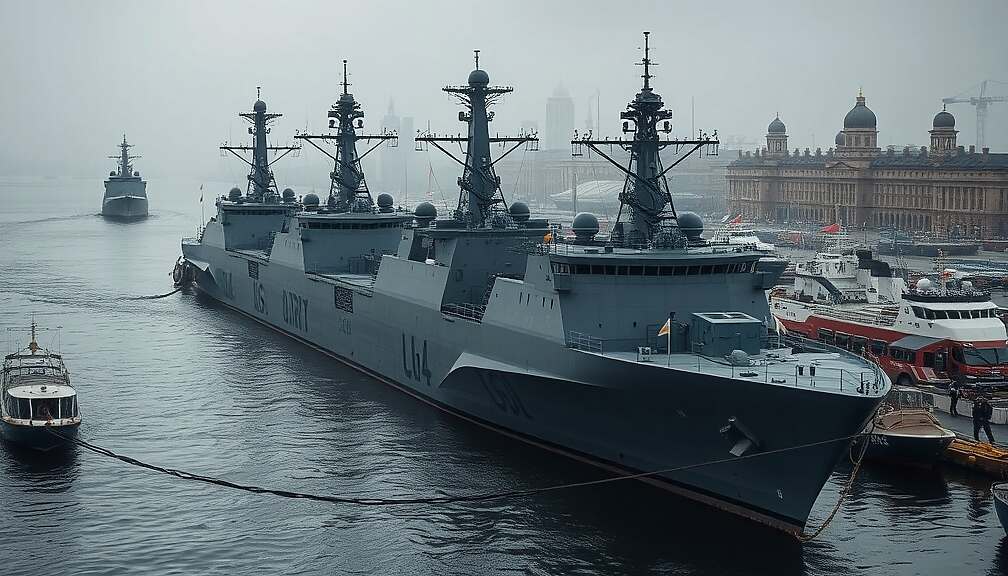
The cancellation of the frigate project-which involved the planned construction of six F126-type ships-was a surprising move by Defense Minister Boris Pistorius (SPD) in June, but it is now facing significant legal scrutiny. Furthermore, several of the Minister’s meetings surrounding the decision have drawn questions. Peter Gauweiler, a lawyer and former CSU politician, told the “Süddeutsche Zeitung” that “it is inevitable to pursue potential professional duty breaches by the Federal Minister, and to comprehensively assert subsequent claims for official liability.” Gauweiler is representing the Dutch shipyard Damen, which was originally set to build the frigates as part of a Europe-wide tender.
Gauweiler had previously notified the members of the Bundestag’s Budget and Defense Committees in a letter stating that Damen intended to claim payment and liability recovery totaling around 4.7 billion euros due to a breach of contract by the Federal Republic. Because of major delays, technological problems, and increasing costs, the Rheinmetall Group had planned to take over the project as the general contractor from Damen. According to the “Süddeutsche Zeitung”, citing its own information, a contract had been negotiated. However, this did not happen when Pistorius officially halted the project on June 24, announcing instead that the government would purchase smaller frigates of the MEKO A-200 type from Thyssen Marine Krupp Systems (TKMS)-the company that had lost the tender in 2020. The missed business opportunity caused Rheinmetall’s stock to drop by approximately ten billion euros.
Because the contract was never finalized, Damen, the shipyard that was leading the project, is now positioned as a potential plaintiff. Gauweiler stated, “Every legal basis was lacking for its withdrawal as well as for the media-driven cancellation.” The damages already stand at 2.3 billion euros and could significantly increase through claims for compensation. Particularly controversial is how the replacement business with TKMS was planned in the background and outside of a competitive tender.
TKMS’s CEO is Oliver Burkhard, a member of the SPD and part of the SPD’s economic forum executive board. Andreas Görgen, who serves on TKMS’s board of directors, is also a top manager and an old acquaintance of Defense State Secretary Jens Plötner. Both had previously worked together under Frank-Walter Steinmeier (SPD) at the Federal Foreign Office. When pressed for details, the Ministry declined to specify who made the decision and when to the “Süddeutsche Zeitung”, stating, “We ask for your understanding that we fundamentally do not comment on internal decision-making processes.”
In response to a questionnaire from the newspaper, the Ministry did concede that it had held specific and numerous discussions with TKMS dating back to April, weeks before the F126 project was officially terminated. The Ministry reported that, during this period, “the Federal Minister of Defence had two meetings with Mr. Burkhard.” One of these appointments was held in collaboration with State Secretary Plötner. Furthermore, Pistorius conducted a phone call with Burkhard, and Plötner made two phone calls with Burkhard during the specified timeframe. However, the Ministry added that these details “may not be complete.”
Andreas Mattfeldt, a CDU budget politician, described the outcome as a “strange progression” when speaking to the “Süddeutsche Zeitung”, noting that the F126 project could have been terminated much earlier due to long-standing problems. Mattfeldt conceded, “Unfortunately, industrial policy disturbances, especially among the industry’s small and medium-sized businesses, were unavoidable.”