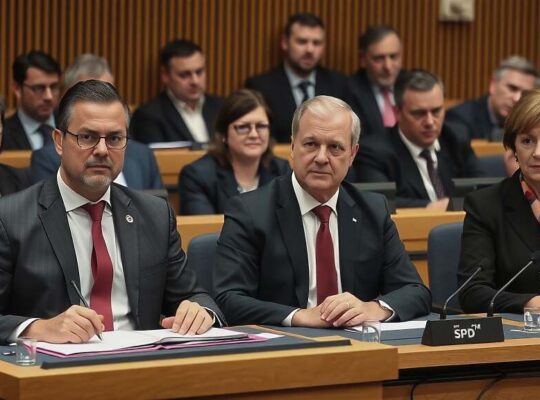
Berlin – Despite simmering tensions stemming from the Social Democratic Party’s (SPD) proposed tax reforms, the German government insists coalition stability remains secure. Government spokesman Stefan Kornelius, responding to inquiries from the dts Nachrichtenagentur on Wednesday, characterized the current state of the governing alliance as “very good” dismissing emerging disagreements as a standard element of the political process.
Kornelius emphasized that the SPD’s proposals, centering on a potential overhaul of inheritance tax, should be considered “standalone” initiatives, declining to offer immediate governmental commentary on their specifics. He framed the internal debates as a necessary facet of democratic decision-making. “It’s a perfectly normal process” Kornelius stated, advocating for a broader perspective on internal political maneuvering, suggesting it should be viewed as a dynamic balancing of competing interests rather than inherently confrontational.
However, the SPD’s plans have already triggered sharp rebukes from within the ruling coalition. Christian von Stetten, Chairman of the Parliamentary Group for Medium-Sized Businesses (PKM), publicly denounced the proposed reforms in an interview with Bild newspaper. Von Stetten characterized the SPD’s tax proposals as a “frontal attack” on German family-owned businesses, suggesting they represent a threat to the fragile coalition peace declared just months ago.
The proposed inheritance tax reforms, details of which remain subject to ongoing internal discussion within the SPD, are reportedly aimed at curbing tax avoidance and ensuring greater fairness in wealth distribution. Critics, particularly those representing the interests of Mittelstand (medium-sized businesses), argue that increased inheritance taxes will disincentivize entrepreneurship and undermine the long-term viability of family firms, a cornerstone of the German economy.
The current disagreement highlights a fundamental ideological split within the governing coalition. While the SPD champions a more progressive tax system to fund social programs and address inequality, the more business-friendly wing, traditionally aligned with the conservative Christian Democratic Union (CDU), voices concerns about potential negative economic consequences. The extent to which the government can manage these conflicting priorities will be a key determinant of the coalition’s long-term survival and its ability to implement a cohesive policy agenda. Whether Kornelius’s assessment of a “normal process” accurately reflects the underlying fragility of a government navigating escalating policy clashes remains to be seen.