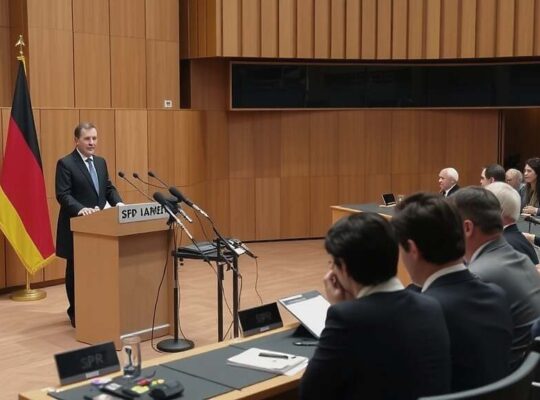
A growing chorus of calls for fundamental reform of Germany’s social welfare system is intensifying, spearheaded by the Confederation of German Employer Associations (BDA). The BDA is urging the Federal-State-Municipal Social State Commission, currently nearing the completion of its mandate, to significantly broaden its scope and to initiate investigations focused on boosting employment rates and incentivizing work participation.
Speaking to “Welt” BDA President Rainer Dulger articulated a core tenet of the proposed overhaul: “Those who work must, without question, receive significantly more than those who do not”. He expressed expectations for an “ambitious program” from the Commission and a similarly robust implementation by the federal government, ultimately aiming for a scenario where individuals can sustain themselves through employment income without reliance on social benefits.
The Commission’s forthcoming final report, slated for release in January, is expected to address the fragmentation and overlap within the current system of state social benefits. The Ifo Institute in Munich recently documented a staggering 502 such benefits, a situation Dulger characterized as resembling “a Franz Kafka novel” highlighting a lack of transparency and accountability in the expenditure of billions in public funds. The BDA emphasizes that the goal isn’t outright reduction, but rather “optimization” particularly through increased digitalization.
Beyond streamlining existing programs, the BDA is advocating for an expanded focus on unemployment insurance, arguing that a parallel process of reform is currently absent, unlike other branches of social security. Furthermore, the structure and function of job centers and employment agencies are identified as requiring urgent revision.
The BDA argues that a modernized social state-one that demonstrably rewards work and focuses assistance on those with genuine need-has the potential to regain public trust and acceptance. However, critics are already raising concerns that the BDA’s emphasis on incentivizing work and reducing reliance on social benefits could disproportionately affect vulnerable populations and potentially exacerbate existing inequalities. The reform proposals are therefore likely to spark intense debate within German society and become a key political battleground in the coming months.