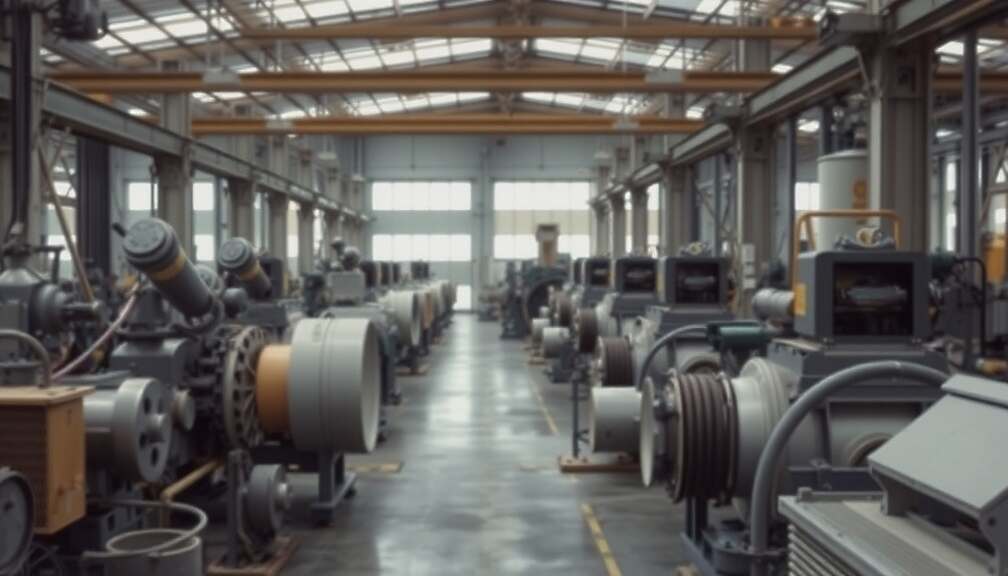
The German economy registered a modest rebound in industrial production during November 2025, according to preliminary data released by Destatis. Production in the manufacturing sector rose by 0.8% compared to October 2025, marking a tentative shift after a prolonged period of weakness. While a three-month comparison showed a 0.7% increase, the figures paint a complex picture of underlying vulnerabilities within the German industrial base.
A significant upward revision of October’s data – now showing a 2.0% increase instead of a preliminary 1.8% – highlights the volatility inherent in these measurements and underscores the fragility of the recovery. Year-on-year, production edged up by a minimal 0.8%, a performance far from indicative of robust growth.
The automotive sector provided a major boost to the overall November figures, experiencing a surge of 7.8% in seasonally adjusted production. Gains in mechanical engineering (+3.2%) and machinery maintenance and assembly (+10.5%) further contributed to the positive, albeit uneven, result. However, a decline in energy generation (-7.8%) tempered the overall gains, reflecting persistent challenges within that critical sector.
Examining the broader industrial production picture – excluding energy and construction – reveals a more substantial increase of 2.1% in November compared to October. Investment goods production saw a notably strong rise of 4.9%, signaling potential for future expansion. Conversely, production of intermediate goods and consumer goods both registered slight declines, indicating continued weak demand in some areas. Construction output also contracted, indicating broader economic headwinds.
Despite the November uptick, the overall trend for the year remains concerning. Production in the manufacturing sector for the period January to November 2025 was 1.2% lower than the same period in 2024. The automotive industry (-2.4%), energy-intensive industries (-2.6%) and mechanical engineering (-2.3%) have borne the brunt of this downturn, reflecting global supply chain issues and shifting consumer preferences.
The performance of energy-intensive industries is particularly worrying. While experiencing a slight increase in a three-month period, production in these crucial sectors remains significantly down – 3.3% lower compared to November 2024. The cumulative decline since 2021 is a stark 17.7%, raising questions about the long-term viability of certain industrial segments and Germany’s ability to meet its climate and energy transition goals. This persistent weakness highlights a dependence on traditional energy sources and a vulnerability to rising energy costs.
Recent indicators, including a surge in truck toll mileage (+3.2%) and improved order book data (+5.6%), offer a degree of cautious optimism, suggesting a potentially strengthening pipeline of demand. However, these signals must be viewed in the context of a longer-term downtrend spanning 2023 and 2024 and the potential for continued volatility in December, the preliminary data for which is expected on February 6th, 2026.
The current recovery feels tentative and risks being easily derailed by external shocks, prompting deeper scrutiny of Berlin’s industrial strategy and its alignment with evolving global economic conditions.