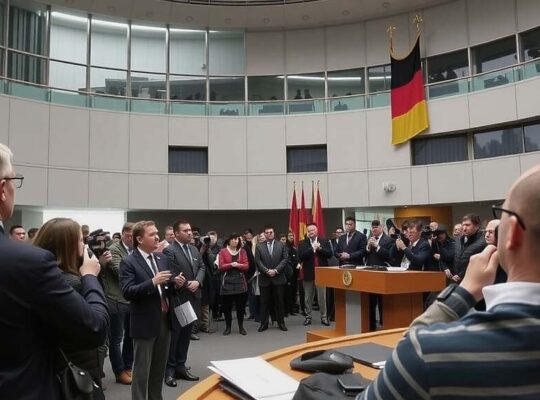
The German Federal Ministry of Culture has announced a significant overhaul of the prestigious Federal Theatre Prize, a move sparking debate regarding its scope and potential political implications within the national arts landscape. Previously geared towards smaller theatres and venues within the independent scene, the redesigned prize now removes “any institutional access restrictions” effectively opening the competition to all theatres regardless of size, ownership, or location.
Culture Minister Wolfram Weimer framed the change as an effort to “broaden the perspective on the entire breadth of the German theatre scene” asserting that artistic excellence transcends factors like institutional structure. The aim, he suggested, is to spotlight the “diversity, creativity and the ability to connect aesthetic innovation with democratic debate” – a deliberately charged statement intended to emphasize the theatre’s perceived role in public discourse.
Critics, however, question whether this expansion dilutes the prize’s original purpose. The previous focus on smaller, often experimental, theatres provided crucial recognition and support to a sector frequently facing funding challenges. Broadening the eligibility to encompass larger, established institutions – often with more robust financial backing – raises concerns that the prize will disproportionately benefit those already well-resourced, potentially eclipsing the voices of independent artists and innovative regional productions.
Beyond the artistic meritocracy claim, the explicitly stated criteria for awarding the prize – including “new approaches to artistic engagement with current societal questions” diverse audiences, ecological and social sustainability and technical-digital innovation – hint at a subtly prescriptive political agenda driving the reform. These criteria, while ostensibly promoting progressive values, could be interpreted as a pressure to align artistic expression with the Ministry’s own priorities, potentially stifling more challenging or politically ambiguous works.
The awarding of a main prize alongside category-specific recognitions (for state/city theatres, private theatres, touring houses and free venues/production houses) further complicates the landscape. The timing of the award, now slated to precede the Berlin Theatre Encounter in April 2026, suggests an ambition to shape the national theatre conversation and reinforce these revised values. The full impact of this restructuring remains to be seen, but it undoubtedly marks a significant moment in the ongoing debate about the role of state funding and artistic freedom within Germany’s cultural sector.