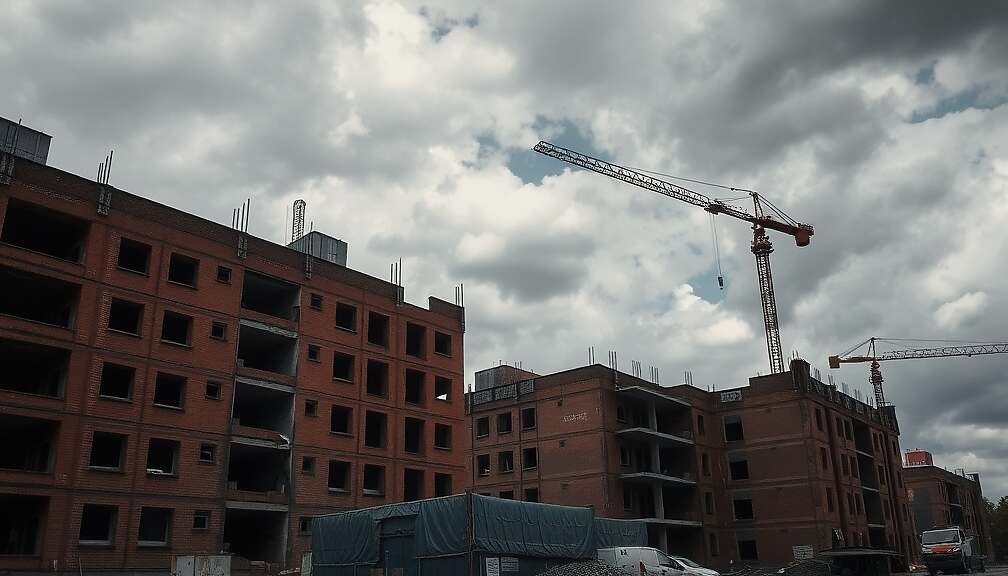
Forecasts from the Euroconstruct research group, which is affiliated with the Ifo Institute, indicate a slowing pace in Germany’s housing sector in the coming years. The number of completed housing units in Germany is projected to drop to 185,000 in 2026. A marginal uptick is expected in 2027, with 195,000 units being completed, although hurdles are anticipated.
If the market outlook had shown some improvement by February, Ifo industry expert Ludwig Dorffmeister noted that the ongoing war in Iran and rising construction inflation are likely to make life considerably more difficult for property developers and builders.
Despite these challenges, the number of completions is expected to rise to 210,000 units in 2028, thus surpassing the 2025 total of 207,000 for the first time. Nevertheless, this figure remains approximately 17% below the level achieved in 2024. Dorffmeister attributes the slow recovery partly to the lengthy period between project approval and final construction, which has increased by about half a year since the beginning of this decade, reaching 27 months.
Looking at the broader European market, the experts anticipate a moderate expansion in construction activity until 2028. Projections show that completed units will reach 1.44 million in 2026 and 1.51 million in 2027. For 2028, the construction experts forecast a completion volume of 1.57 million units across the continent. Dorffmeister specifies that while countries like Spain, France, and Great Britain are expected to see significantly higher numbers of completed homes in the coming years, Germany and Italy are only expected to see slight increases.
Overall, the European construction economy is projected to expand by two percent annually between 2026 and 2028. While the housing construction segment, driven by new builds, is set to return to a growth trajectory in 2026 after three years of contraction, the dynamic in deep construction (underground work) is expected to steadily decrease until 2028. Furthermore, the non-residential (office/industrial) construction segment lacks a clear trend, though it is anticipated to reach its largest positive growth in 2027.