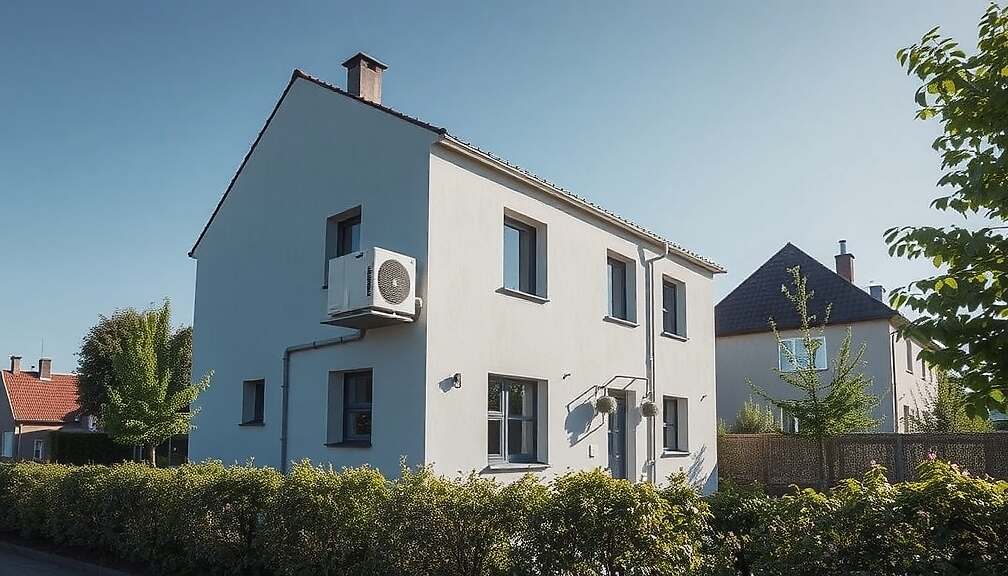
In Germany, an ever-increasing share of new residential buildings is being heated using heat pumps. According to the Federal Statistical Office (Destatis) on Wednesday, heat pumps are now used as the primary source of heating energy in nearly three-quarters (73.6 percent) of the approximately 58,900 residential buildings completed in 2025.
This figure represents a significant increase compared to 2024, when heat pumps were the main heating technology in 69.4 percent of the roughly 76,100 completed buildings. Over the past decade, the adoption rate has more than doubled; in 2015, heat pumps were the primary technology in 31.4 percent of the 105,600 buildings completed. Heat pumps draw upon geothermal and environmental thermal energy, both of which are categorized as renewable sources.
The use of heat pumps is particularly widespread in detached (single-family) and semi-detached (two-family) houses. In 2025, 77.9 percent of all new single-family homes and 78.4 percent of new semi-detached homes primarily utilized a heat pump for heating. Their application was notably less common in new apartment buildings with three or more units, standing at 52.7 percent.
Overall, close to four out of every five newly constructed buildings in Germany are now predominantly heated by renewable energy. In 2025, renewable sources were the main heat source in 78.2 percent of residential buildings, up from 38.0 percent in 2015. Renewable energies used for heating include earth or air-source heat pumps, wood (such as pellet heaters or fireplaces, accounting for 3.5 percent as the main source in 2025), solar thermal energy (0.6 percent), biogas/biomethane (0.4 percent), and other biomass (0.2 percent).
When counting supplementary energy sources, the overall penetration is even higher: renewable energies were utilized in 85.2 percent of all new residential constructions in 2025, regardless of whether they were the primary or a secondary source (this figure was 61.5 percent in 2015).
For primary energy sources, natural gas was the second most important energy source in 2025, used in 10.5 percent of completed buildings. This is a decrease from 15.0 percent in 2024, when gas heating served as the main energy source in housing construction. In contrast, over half (51.5 percent) of the buildings completed in 2015 were predominantly heated by natural gas. Following heat pumps and gas heating, district heating is the third most critical main energy source for new homes, utilized in 8.3 percent in 2025. Oil heaters accounted for a negligible 0.3 percent, installed in only 190 new buildings in 2025.
This transition toward renewable heating is also evident in the planning phase. Of the 62,100 residential buildings approved for 2025, 87.0 percent are planned to be predominantly heated by renewable energy. In the vast majority of these cases, heat pumps are planned as the main system, slated for 83.0 percent of approved new buildings. Conventional natural gas is playing an ever-smaller role in the planning process, utilized by 2.2 percent.
In contrast, in existing housing stock, natural gas remains the dominant primary energy source. According to the 2022 census, more than half (53.9 percent) of existing residential buildings are heated by natural gas. About a quarter (24.7 percent) of these buildings use heating oil. In the total existing stock in 2022, renewable energy sources only played a minor role, accounting for 10.2 percent. Specifically, 4.2 percent of existing residential buildings are heated using solar or geothermal systems, or environmental or exhaust air heat (typically utilizing heat pumps).