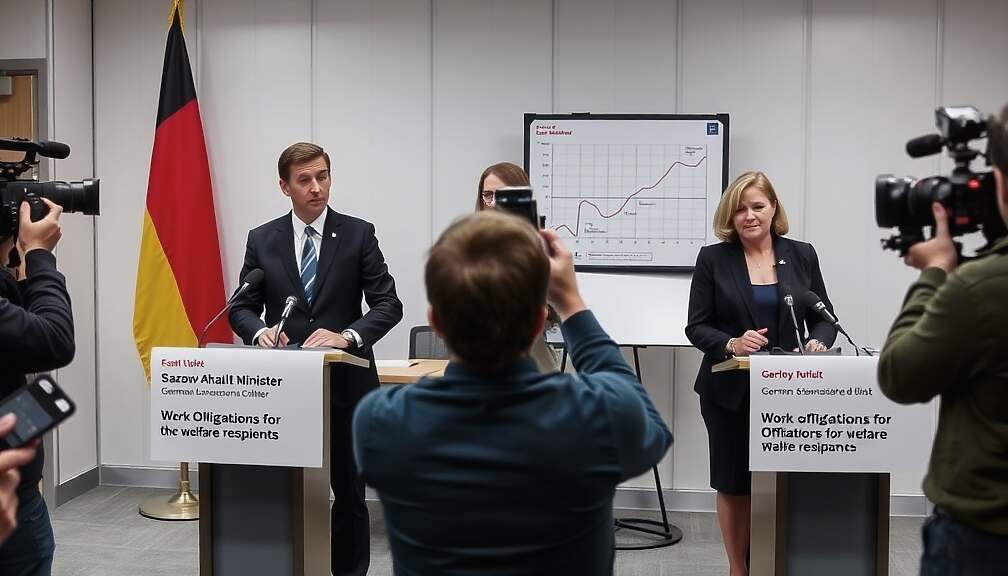
The proposal by Saxony‑Anhalt’s Minister‑President Sven Schulze (CDU) to impose a work obligation on recipients of the “citizen’s benefit” has drawn skepticism from the Federal Ministry of Labour, headed by Bärbel Bas (SPD). While a spokesperson for the “Bild” (Monday edition) conceded that job placements could help stabilize daily routines and encourage cooperation, she stressed that such placements must be temporally limited, individually justified, and integrated into a broader strategy for social participation. The precise implementation is left to local job centres.
The spokesperson also warned of the associated costs. “Providing non‑profit work opportunities involves substantial expenses and administrative effort-for example, organising the placements and supervising the work. These costs add to the existing regular benefits” she said. “The priority must therefore always be to integrate benefit recipients into regular employment”.
Schulze defended his stance, insisting that a work obligation is both feasible and necessary. “It’s doable, and it must be done. The bureaucratic burden will be relatively low” he told the newspaper. “If people want it, they’ll get it. If they don’t, they’ll find excuses, just like the Federal Ministry of Labour does”. He said he would demonstrate in Saxony‑Anhalt that such a requirement is viable and would present a timetable in the coming days, adding that the state should not be allowed to drift without responsibility.
Under Article 12 of the German Constitution, no one may be forced to undertake specific work. The only exceptions are court‑ordered deprivation of liberty and a universal public‑service duty. However, under Paragraph 16d of the Second Section of the Social Code (SGB II), citizens’ benefit recipients may be bound to participate in so‑called “work opportunities” designed to maintain employability. Participation is considered a civic duty and can already now be penalised by reductions to the benefit.
Earlier, a stricter work obligation had first been brought to the forefront by the AfD parliamentary group. In October 2023 they proposed that unemployment‑benefit recipients who refused “citizen work” should no longer receive cash support but only in‑kind services.