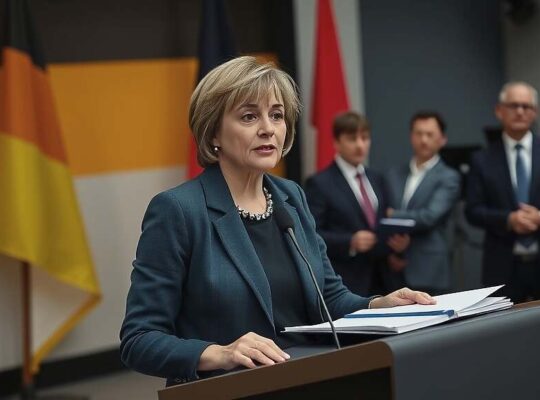
The Bundestag’s President, Julia Klöckner of the Christian Democratic Union (CDU), is pushing for legislative changes to prevent individuals deemed security risks from being employed within parliamentary offices, even if they lack formal access to the Bundestag building. In a move signaling heightened concerns about internal security, Klöckner told the Redaktionsnetzwerk Deutschland that employing individuals posing a threat to the parliament is “unacceptable” and conflicts the principles of a secure legislative environment.
Currently, a loophole allows individuals denied security clearances – and therefore a Bundestag access pass – to still be legally employed by parliamentarians. Klöckner argues this situation undermines security protocols, stating, “We cannot lock the front door but leave the back door open”. She intends to propose amendments to the Abgeordnetengesetz (Parliamentary Act) to rectify this inconsistency.
The potential change would effectively prohibit the continued employment of individuals flagged for security concerns, even if their roles don’t require direct building access. Klöckner emphasized that the proposed regulation should be applied as broadly as possible, encompassing not only parliamentary offices in Berlin but also district offices across the country.
This initiative follows recent instances where the Bundestag denied access passes to several employees of parliamentarians, prompting intense scrutiny. While the Bundestag administration has declined to provide specifics, the Alternative for Germany (AfD) faction claims several of their employees were impacted.
Klöckner attributed the denials to “security-relevant concerns, prior convictions and other irregularities”. She explicitly stated that individuals with documented rejection of Germany’s democratic system should be barred from accessing the building and its IT networks. This proposal raises complex questions regarding due process and potential for political targeting, with critics likely to scrutinize the criteria for determining “security relevance” and ensure proper oversight to prevent abuse of the new regulations. The move is likely to ignite a political debate centered on balancing security concerns with the rights of individuals and the independence of parliamentarians.