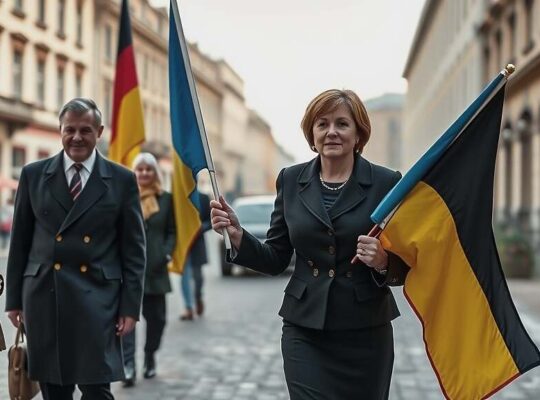
European leaders across the political spectrum have strongly condemned recent remarks by US President Donald Trump, who warned of Europe’s potential “destruction” through migration in a recent interview with “Politico”, specifically citing Germany as a cautionary example. The criticisms highlight a deepening rift in the transatlantic relationship and raise serious questions about the future of US-European cooperation.
Adis Ahmetovic, the SPD’s spokesperson for foreign policy in the Bundestag, characterized Trump’s statements as a deliberate tactic aimed at weakening Europe and bolstering authoritarian forces. He described the US’s evolving security strategy as an “open attack” on Europe’s sovereignty, arguing that the US is no longer a partner on an equal footing and that Europe must consequently assert greater independence. This perspective aligns with a growing sentiment within the SPD, advocating for a reassessment of the traditional transatlantic alliance.
While Jürgen Hardt, the CDU’s spokesperson on foreign policy, also rejected Trump’s assessment, he emphasized the continued importance of the transatlantic partnership. He acknowledged the validity of Germany’s economic and scientific prowess, urging US officials to more effectively communicate these strengths. However, his insistence on the partnership’s value appears increasingly strained given the escalating rhetoric.
The Green Party echoed this sentiment of rejection, with party leader Franziska Brantner asserting that Trump’s comments are part of a strategy designed to sow division and undermine European stability. Brantner specifically pointed to the US President’s apparent misrepresentation of Germany’s energy transition, framing it as a threat instead of a vital step toward energy independence.
Several politicians urged caution against reacting excessively to Trump’s provocations. Agnieszka Brugger, the Bundestag’s Deputy Parliamentary Group Chair, suggested his statements were intended to provoke and cautioned against taking them at face value. Echoing this sentiment, Roland Theis (CDU), spokesperson for the CDU faction in the European Committee, delivered a sharp rebuke to Trump, stating that his behavior risks turning allies into vassals. He dismissed Trump’s view as delusional and reinforced the need for Europe to resist both internal and external divisions.
The backlash against Trump’s comments underscores a palpable shift in European attitudes, with many now openly questioning the reliability and strategic intentions of the United States. While stressing the historical significance of the transatlantic alliance, European political figures are increasingly recognizing the necessity of forging a more independent and self-assured European identity. The long-term implications for the US-Europe relationship remain to be seen, but recent events suggest a period of significant realignment may be underway.