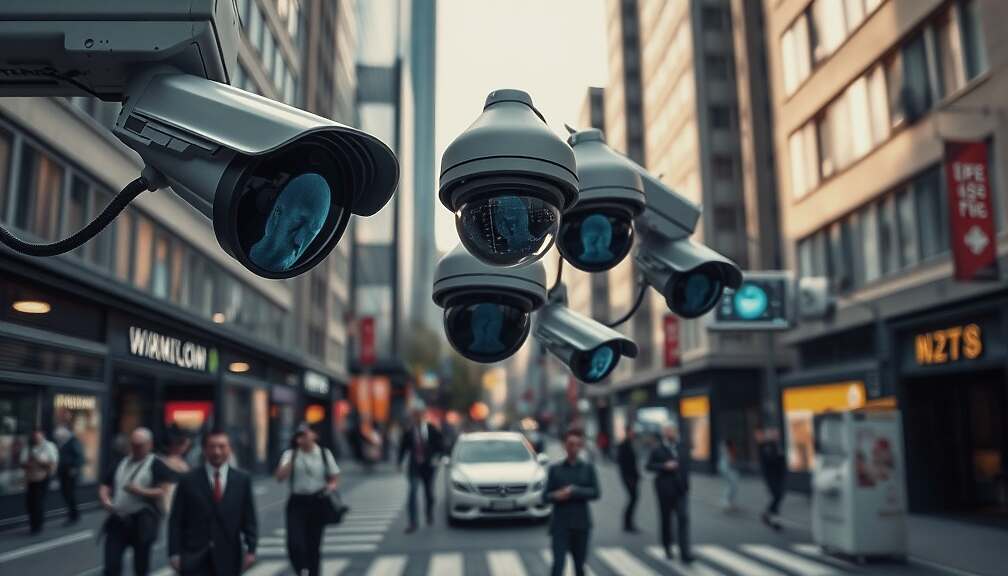
The parliamentary factions of the CDU/CSU and the SPD are pushing for a legislative change that would allow the Federal Police to perform biometric matching on live footage from surveillance cameras. This proposal emerges from an amendment to the Federal Police Act, which a magazine called Politico has reported on, with the law slated for final debate in the Bundestag this Friday.
The proposed new Section 31b would establish a power for “Biometric Detection in Real Time.” Essentially, the Federal Police would store the biometric data of specific individuals and automatically compare it against camera recordings immediately after the footage is captured. This regulation is justified by the EU’s AI ordinance, which while generally prohibiting real-time biometric searches in public spaces, does allow for exceptions. The Federal Police intends to utilize this “possibility opened up by European law.”
The use of this system would be limited to cases of particular severity, including acute threats to the state or human life. The system would also be used to search for suspected terrorists, victims of kidnapping, human trafficking, or sexual exploitation, as well as missing persons facing a “serious threat” to their life or health.
According to the draft, judicial approval is fundamentally required for the measure. Therefore, the Federal Police must request a court order before storing a person’s biometric data and comparing it with real-time camera footage. However, in emergency situations, the Federal Police is initially permitted to act independently, provided a judicial decision is sought “immediately, no later than within 24 hours.”
Operational safeguards are also built into the draft. Any automated match must be independently reviewed by two police officers trained in AI before the data is further processed. If a match is not confirmed, the gathered data cannot be saved. The real-time search is set to be temporary, limited to 72 hours, though extensions are possible. Furthermore, the draft stipulates that the system may only access images transmitted in real time; accessing previously stored footage is prohibited. Additionally, the linking of the biometric dataset with other data and databases is expressly forbidden.