The impending visit of Syrian transitional President Ahmed al-Sharaa to Berlin has prompted cautious optimism and sharp demands from German politicians, underscoring the complexities of navigating a path toward reconciliation and reconstruction in war-torn Syria. While officially welcomed, the visit is viewed by many in the German political landscape as a crucial test of al-Sharaa’s commitment to genuine national unity and stability.
Jürgen Hardt, the CDU/CSU’s spokesperson for foreign policy in the Bundestag, voiced clear expectations, stating that al-Sharaa must “dispel doubts” regarding Syria’s trajectory under his leadership. He emphasized the profound challenge facing the transitional government: uniting a nation fractured by years of brutal civil war, requiring inclusive representation of all ethnic and religious groups. Hardt stressed that al-Sharaa’s promises of reconciliation will be rigorously scrutinized.
SPD’s foreign policy spokesperson, Adis Ahmetović, echoed these sentiments, arguing that the visit must be framed by “clear expectations and demands” including the protection of civilian populations, an immediate cessation of military offensives and unimpeded humanitarian access. The recent attacks targeting Kurdish communities in Aleppo, he noted, have fostered significant skepticism about the transitional government’s ability to ensure inclusivity and isolate extremist factions.
Concerns extend beyond the Kurdish community. Kassem Taher Saleh, a Green Party MP and chairman of the Bundestag’s cross-factional “Kurdish Life” parliamentary circle, insisted that the meeting be accompanied by “clear red lines”. He warned that welcoming a transitional president under whose watch minority groups face persecution risks undermining the legitimacy of the process. Taher Saleh, himself a Kurdish refugee from Iraq, highlighted the widespread fear among Druze, Yazidis, Alevites, Christians and other minorities in Syria, arguing that the failure to guarantee their protection would forfeit any claim to political legitimacy.
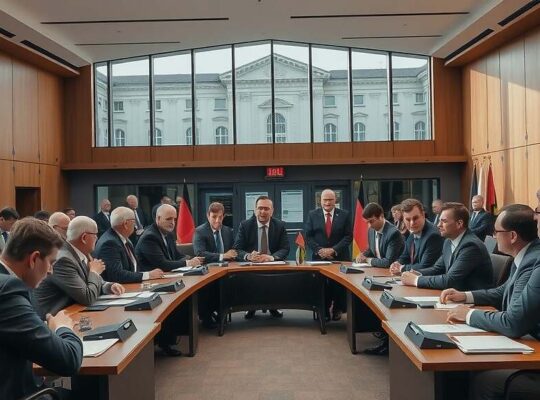
The schedule for al-Sharaa’s visit, commencing Monday and culminating in a meeting with Chancellor Friedrich Merz on Tuesday, includes a media encounter and a roundtable discussion with Economy Minister Katherina Reiche, Foreign Minister Johann Wadephul and representatives from German business and industry. This economic focus, however, is layered with political complexities, raising questions about the potential for engagement with a government still facing profound internal challenges and external pressures.
The visit has also drawn significant protest. Several organizations have organized a demonstration scheduled for Monday afternoon in front of the Brandenburg Gate, signaling a deep-seated unease amongst Syrian diaspora communities and human rights advocates regarding the optics of welcoming al-Sharaa under the current circumstances. The protests serve as a stark reminder of the political sensitivities surrounding Syria’s future and Germany’s role in shaping it.