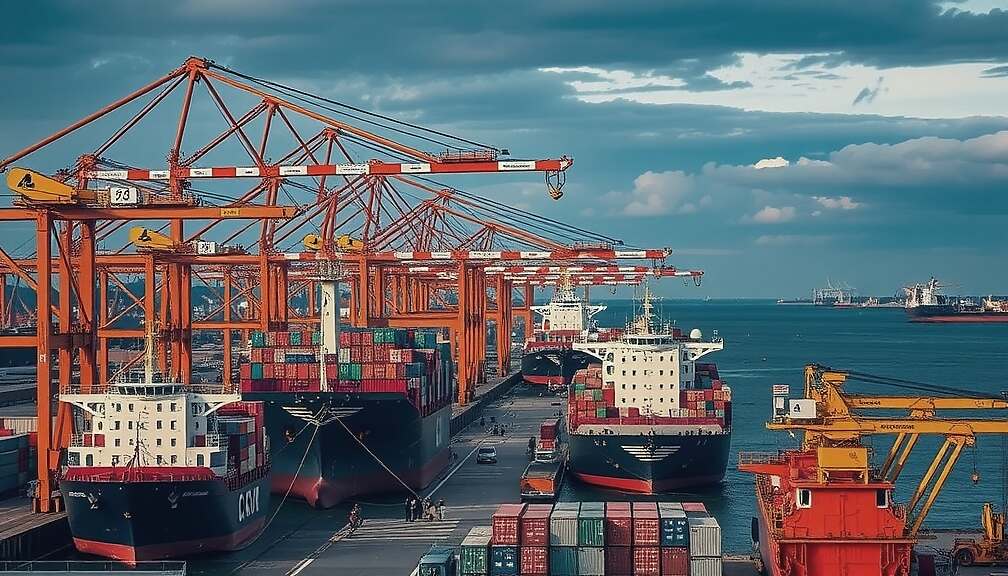
German sea‑port cargo handling rose 3.8 % in 2025 compared with the year before, reaching 284.4 million tonnes of goods loaded – up from 273.9 million tonnes in 2024.
Imports from abroad grew 5.3 % to 171.1 million tonnes, while exports to other countries increased only 0.5 % to 103.7 million tonnes. Domestic traffic, although 15.7 % higher, accounted for just 9.6 million tonnes and represented a small share of the overall turnover.
Hamburg remained the busiest German seaport, handling 99.8 million tonnes (+2.9 % from 2024). It was followed by Bremerhaven (46.9 million tonnes, +10.4 %), Wilhelmshaven (35.5 million tonnes, +2.7 %), Rostock (24.9 million tonnes, +7.2 %) and Lübeck (15.8 million tonnes, -0.4 %).
The largest cargo category in 2025 were the so‑called “unidentifiable goods” – mainly container loads without detailed product descriptions – which totaled 87.9 million tonnes and comprised 30.9 % of total handling. Fossil energy carriers (coal, oil and gas) followed with 40.5 million tonnes (14.2 %). Ore, stone and mineral earths were next (31.1 million tonnes, 10.9 %), and chemical products accounted for 20.2 million tonnes (7.1 %).
In terms of imports, fossil energy carriers again dominated. Coal, oil and gas totals 39.8 million tonnes, a slight decrease of 1.2 % from 2024. Oil imports fell 10.8 % to 25.4 million tonnes, whereas coal rose 2.6 % to 7.0 million tonnes and gas surged 49.1 % to 7.4 million tonnes.
For natural gas, the United States supplied by far the most, delivering 6.5 million tonnes – a 51.8 % increase on the previous year. Although oil imports from the U.S. fell 23.6 % to 5.6 million tonnes, the U.S. still out‑topped Norway as the leading supply country, which saw its oil deliveries slide 27.7 % to just under 5.6 million tonnes. For coal, the U.S. also led in 2025 with 2.0 million tonnes (+0.1 %). These numbers represent a rise in US-EU energy imports even without a ratified trade agreement.
Total trading volume between German and US sea ports fell 3.6 % to 28.7 million tonnes. Nevertheless, the U.S. remained Germany’s top maritime partner, with Norway second (26.3 million tonnes, +1.8 %) and Sweden third (24.6 million tonnes, +3.6 %). China placed fourth with 19.7 million tonnes (+3.1 %). Together, these four states accounted for just over a third of all German sea‑port cargo. Trade with EU Member States was 99.4 million tonnes, up 3.3 %.
Container traffic reached 15.0 million TEU, a 12.4 % increase from the previous year. Roughly one‑fifth (3.0 million TEU) of the German container volume was destined for China, followed by the United States at 1.3 million TEU (8.7 %). Container traffic with China grew 12.1 %, while that with the U.S. fell 2.4 %. Container flows to EU countries rose 13.1 % to 4.1 million TEU, making up just over a quarter of total German port handling.
Cargo flows to Persian Gulf littoral states were comparatively small: about 4.0 million tonnes – 1.4 % of total – were sent to Bahrain, Iraq, Iran, Qatar, Kuwait, Oman, Saudi Arabia and the UAE. In 2025 the volumes were 1.4 million tonnes to Oman, 1.2 million to the UAE, 0.9 million to Saudi Arabia, and none to Iran.
Most freight to Oman came from containerised, unidentified goods (0.9 million tonnes), and the majority of goods sent to the UAE were furniture (0.2 million tonnes). Conversely, the bulk of cargo received from Saudi Arabia – 0.5 million tonnes – was liquid mineral oil products (including fuels and lubricants). Similar patterns were seen for Kuwait (0.3 million tonnes) and Qatar (0.2 million tonnes), with almost exclusively liquid petroleum products shipped to German ports.
Because many goods from Gulf states are first routed through major foreign ports in the Netherlands, France, Italy and Belgium before arriving in mainland Europe, maritime blockades in the Middle East can indirectly affect Germany’s supply chain.