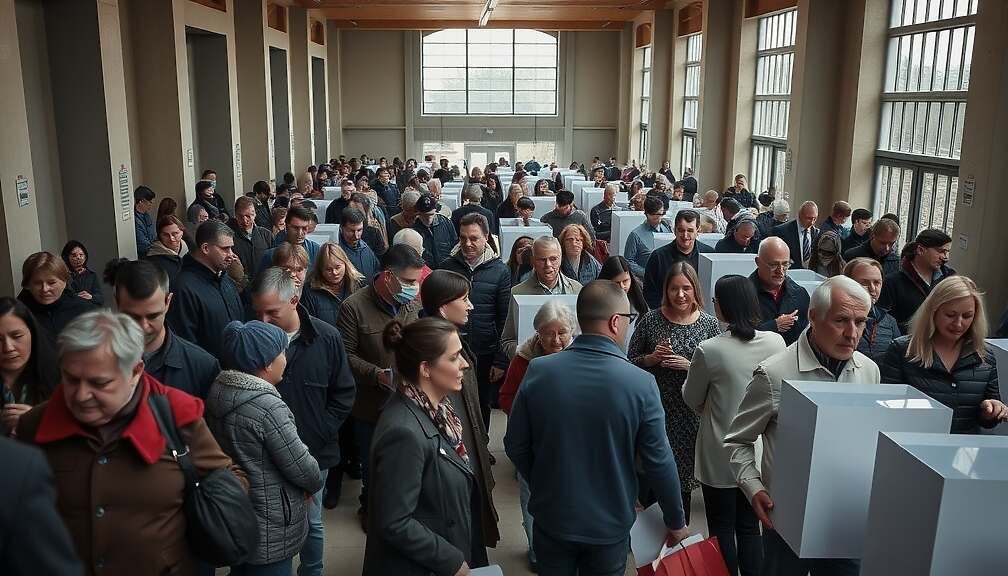
State parliament elections began Sunday morning in both Berlin and Mecklenburg-Vorpommern.
In the capital city, approximately 2.5 million people are entitled to vote in the election for the 20th Berlin House of Representatives (Abgeordnetenhaus). Eligibility is restricted to German citizens aged 16 or older who have resided in Berlin for at least three months. The parliament consists of 130 regular seats, which may be increased by overhang and compensation mandates, and district council elections are taking place simultaneously.
Current polls suggest a tight three-way race involving the Christian Democratic Union (CDU), the Left Party (Die Linke), and the Alternative for Germany (AfD) for claiming the strongest position. Since all other parties have rejected collaboration with the AfD, Stefan Evers (CDU) and Elif Eralp (Linke) are seen as the most viable candidates to succeed the current governing mayor, Kai Wegner (CDU). Wegner had announced his withdrawal from the CDU’s top candidacy after increasing criticism regarding the handling of the power grid attack on Berlin.
Meanwhile, in Mecklenburg-Vorpommern, around 1.3 million individuals are eligible to vote in the election for the ninth state parliament. The parliament is composed of at least 71 members, and any German citizen aged 16 or older who has lived in Mecklenburg-Vorpommern for at least 37 days may participate.
While early forecasts suggested that the AfD would achieve a landslide victory, its results from five years ago, the Social Democratic Party (SPD) led by Minister-President Manuela Schwesig has significantly closed the gap in recent months, even surpassing the AfD in certain public opinion surveys, such as the ZDF political barometer. This indicates an even contest between the SPD and the AfD, giving Schwesig strong prospects of remaining head of government. In contrast, the CDU, Green Party, and BSW are struggling to cross the five-percent electoral threshold in the surveys.
Both state elections are expected to have significant ripple effects on federal politics. A weak performance by the CDU could put further strain on Chancellor Friedrich Merz. In a decisive move, Merz has already called a formal meeting of the complete CDU party executive for Sunday afternoon at the CDU headquarters in Berlin to discuss the voting results.
Polling stations will close tonight at 6 PM, after which projections and analyses from post-election surveys are expected.