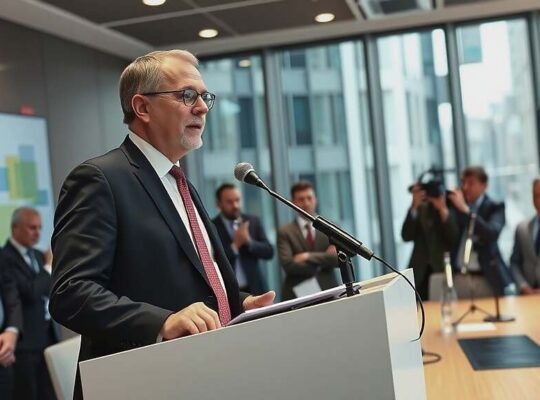
Sepp Müller, the co‑chair of the Bundestag Taskforce “Economic Impact of the Iran War”-which brings together the CDU/CSU and SPD parliamentary groups-sent a warning to the oil majors after fuel prices surged. In an interview with “Die Welt”, he said: “We want to understand how this pricing has arisen, as it is inexplicable to us. We have means to influence fuel prices. The toolbox that we have should give the companies something to think about”.
Müller added that it would be unwise to reveal details today, but everyone knows what powers the Federal Cartel Office possesses-from levying penalties to imposing regulatory market interventions. “If we uncover price‑fixing or otherwise incomprehensible pricing schemes, the cartel office has sufficient tools to intervene and put a stop to it” he stated.
This was the taskforce’s first meeting on Friday. Müller tempered any expectations that the prices could be curbed quickly: “Sincere policy is honest. Therefore there won’t be an equally abrupt political response to the sudden price rises. Even the mere public speculation about measures-such as a fuel discount-would immediately trigger a market reaction”. He warned that merchants and speculators would adjust their expectations and bet against the policy, potentially sparking a new price spiral. “In such scenarios, responsible politics means deliberately avoiding quick signals” Müller explained.
The CDU politician does not anticipate another steep rise in petrol and diesel. “There is enough oil and fuel on the market. Germany faces no supply bottleneck. Consequently, as of today, we do not foresee any further major price spikes”. He also doubts that inflation will jump significantly. “If the conflict remains limited in time, we are unlikely to see an inflation jump; we would only see a modest increase of about 0.3 to 0.5 percentage points. Should the war drag on longer, there could be an overall inflation rise of more than one percentage point” Müller said. “In specific areas, the impact could be much higher-particularly in logistics or electricity prices, where the gas price feeds into the energy cost. That effect ripples through the value chains”.