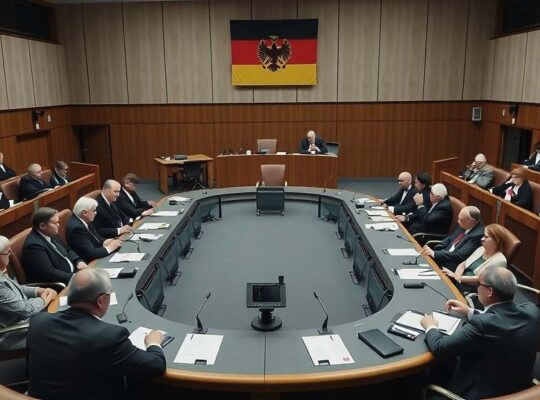
The German Bundestag approved a sweeping overhaul of military service Friday, a move sparking immediate debate over its efficacy and potential impact on civil liberties. In a close vote – 323 in favor, 272 against, with one abstention – lawmakers passed the Wehrdienst-Modernisierungsgesetz, a law intended to modernize and potentially bolster the nation’s armed forces.
The new legislation, born from protracted internal conflict within the governing coalition, initially emphasizes voluntarism. Beginning in 2026, all 18-year-old citizens, both male and female, will receive questionnaires designed to assess their suitability and motivation for military service. While the questionnaire response will be mandatory for men, it remains voluntary for women. Those men born on or after January 1, 2008, will face a reinstatement of compulsory military service under the new framework.
The core of the legal change hinges on the creation of an “Aufwuchskorridor” a projected growth in volunteer recruitment. Should this target not be met, contingency plans for a “Bedarfswehrpflicht” or compulsory military service based on need, will be triggered. However, enacting this secondary stage necessitates a further parliamentary vote, a point that fueled considerable coalition discord and previously involved discussion of a lottery system to determine conscription.
Significantly, the legislation attempts to incentivize participation through substantial financial compensation. Those volunteering for military service will receive a gross monthly salary of at least €2,600, while career soldiers (SaZ) will be compensated at €2,700, along with accommodation. The law also promises to prioritize stationing recruits close to their place of residence.
The financial incentives extend further, with the prospect of driver’s license subsidies for those committing to at least a year of service, alongside compensation based on the Federal Soldiers’ Pay Act. The minimum service duration is set at six months, although individuals can potentially extend their commitment for up to 25 years, provided they meet suitability criteria.
Critics are already raising concerns. The reliance on voluntary recruitment, coupled with the complexity of triggering a compulsory service element, has been characterized as a gamble by some political commentators. Questionable is whether the generous financial inducements will prove sufficient to meet recruitment targets, or if the system will ultimately prove to be an expensive and ultimately ineffective measure to address Germany’s defense needs. Furthermore, the mandatory questionnaire for men, despite the voluntary nature for women, raises questions of potential discrimination and disproportionate burden. The system’s long-term impact on individual freedoms and the potential for escalating societal divisions remain to be seen, marking the beginning of a contentious period following the legislation’s approval.