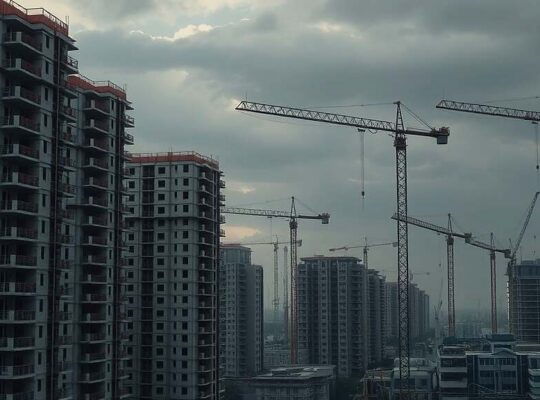
A national shortage of approximately 1.35 million housing units is estimated in Germany, according to the new “Bau-Monitor 2026.” This report was compiled by the Pestel Institute on behalf of the Association of German Building Materials Trade (BDB) and was reported on by the “Rheinische Post”.
The largest deficit is found in North Rhine-Westphalia, the most populous state, which is lacking 360,000 homes. Bavaria has a shortage of around 220,000 dwellings, while Berlin needs nearly 60,000 more apartments.
Matthias Günther, CEO of the Pestel Institute, described the situation to the newspaper, stating, “We need far more housing than ever before, and we are building far too little.” He characterized this combination as “toxic”-a clear case of market failure.
Günther warns that this housing crisis could impede job growth. While Germany requires immigration to address the skilled labor shortage, it is failing to build adequate housing for newcomers. He asserted that without closing the housing deficits, Germany will struggle to recover economically, concluding, “We are not working too little; we are simply too few to work.”
To combat the mounting crisis, the BDB is calling for acceleration of legislation concerning the E-type building standard. Katharina Metzger, President of the BDB, noted that addressing this standard is a critical way to lower construction costs and make housing affordable again. She pointed out that current practices often establish standards that exceed legal requirements, which heavily drive up costs.
The Pestel Institute noted that the current housing deficit is slightly lower than the previous peak figure of 1.4 million units. This reduction is attributed to both a slight decrease in immigration and the country’s demographic trends.