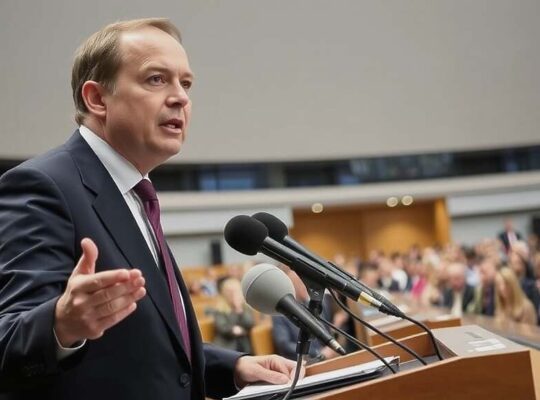
Germany’s Minister for Digital Affairs, Karsten Wildberger, has ignited a debate within the European Union regarding the continent’s reliance on the United States in the burgeoning field of artificial intelligence. In an interview with “Die Zeit”, Wildberger, a member of the Christian Democratic Union (CDU), argued for a strategic shift away from dependence, advocating for partnerships built on mutual equivalence rather than asymmetric influence.
The core of Wildberger’s argument centers on fostering European technological sovereignty and ensuring a greater share of the value creation associated with AI development. He contends that past regulatory approaches have inadvertently hindered European innovation by imposing excessive burdens on businesses. While acknowledging the importance of landmark legislation like the Digital Services Act (DSA) and the Digital Markets Act (DMA), Wildberger emphasized the need for a more balanced regulatory framework that doesn’t stifle entrepreneurial dynamism.
The irony of the Minister’s position is not lost on observers. Wildberger himself admits to being a frequent and enthusiastic user of US-developed AI tools. He revealed he regularly engages with the Claude chatbot, developed by American firm Anthropic, sometimes for sessions lasting up to two hours daily, using it to discuss personal thoughts. This personal reliance on US technology, while demonstrating a recognition of its current capabilities, underscores the considerable challenge of disentangling Europe from existing technological infrastructures and dependencies.
The declaration has triggered a wave of scrutiny and raised questions about the practicality of achieving technological independence from a nation dominating the AI landscape. Critics suggest Wildberger’s call for parity lacks a concrete roadmap and risks alienating vital transatlantic partnerships. However, the conversation highlights a growing sentiment within Germany and across Europe: a desire to define a more assertive and strategically independent role in the future of artificial intelligence. The political pressure is now on to translate this ambition into tangible policy initiatives that can genuinely level the playing field and cultivate European innovation without sacrificing the potential benefits of global collaboration.