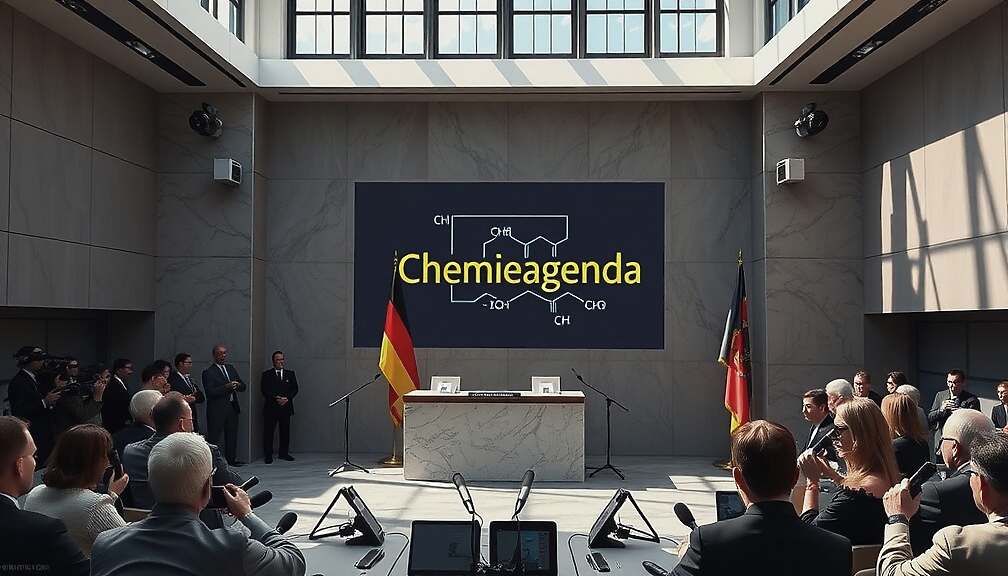
According to Politico, citing the federal government’s new Chemistry Agenda, several short‑term “immediate measures” are slated for implementation by the end of 2027. Federal Ministers of Economy Katherina Reiche (CDU) and Environment Carsten Schneider (SPD) plan to present the Chemistry Agenda 2045 at noon.
Key immediate actions include the planned launch of an industrial electricity price and an expansion of electricity‑price compensation. From this year onward, the agenda’s second phase, “Transformation and Scaling” will run through the 2030s, followed by a third phase, “Industrial Transformation and Technological Leadership”. The overarching goal is to make Germany the world’s most innovative hub for chemistry, pharmaceuticals, and biotechnology.
In the area of emissions trading, the strategy paper proposes leveraging the upcoming ETS‑1 reform in Brussels this summer to better align competitiveness with climate protection. The government supports “structural adjustments to the benchmark devaluation” so that protection against carbon leakage is strengthened without disadvantaging carbon‑neutral technologies. Moreover, ETS certificates are to remain available on the market even after 2039, with the linear reduction factor flattened from 2036 onward.
The CO₂ border adjustment mechanism (CBAM), designed to raise the cost of importing CO₂‑intensive products, is said to “not provide the chemical industry with carbon‑leakage protection for the foreseeable future”. The agenda highlights that carbon leakage-the risk of industry relocating to third countries to avoid increased price costs from CO₂ certificates-remains a concern. It criticises the CBAM for potential circumvention and the heavy bureaucratic load it imposes.
The Clean Industrial Deal State Aid Framework (CISAF), the subsidy framework for industry, is to be expanded so that the stated target of an industrial electricity price of €50 per MWh is reached and a long‑term contribution to easing electricity costs can be delivered. Expansion of natural‑gas supply is planned to secure competitive prices. The government will examine whether the RFNBO industry quota should be adjusted to the realities of the hydrogen boom, and CO₂ differential contracts are to be made permanent.
The agenda’s development involved, besides the two ministries cited, the finance, labor, research, digital, and chancellery ministries. State governments, industry groups, and trade unions were also consulted. The agenda covers energy and climate policy, innovation, regulation, and competitiveness.