The German Green Party is signaling a potential shift in its stance on military involvement in Ukraine, with leadership suggesting a willingness to consider Bundeswehr deployments to secure a future ceasefire. Franziska Brantner, co-chair of the Greens, articulated this position in an interview with the Süddeutsche Zeitung, emphasizing that Germany cannot shirk its responsibilities if Ukraine requests assistance in maintaining a cessation of hostilities. However, she stressed that such intervention would be conditional, excluding the deployment of German soldiers into active combat zones. The rationale behind this potential move, according to Brantner, is the crucial need to deter Russian President Vladimir Putin and safeguard German security.
Brantner’s remarks also contained a sharp critique of the current approach taken by German Chancellor Friedrich Merz, drawing comparisons with the assertive foreign policy of former U.S. President Donald Trump. She argued that a more resolute stance from Merz is necessary, advocating for stricter boundaries and a willingness to firmly assert “enough is enough” in international affairs. She specifically cited the Venezuelan crisis as a scenario where a harder line was warranted.
The increasingly unpredictable nature of U.S. foreign policy, exemplified by the recent developments concerning Greenland, has further fueled Brantner’s call for greater European autonomy. She warned against complacency, stating that the notion that current American behavior is merely a temporary deviation from established norms is “irresponsible.
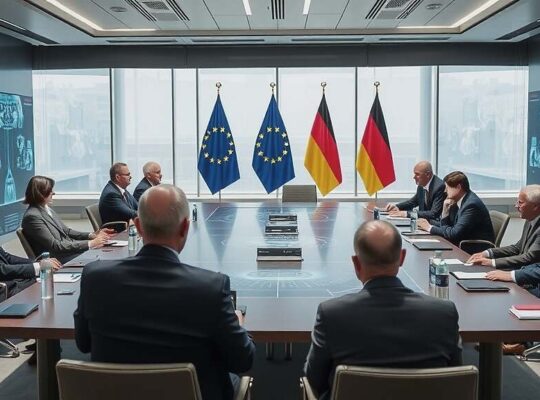
This sentiment underpinned a forceful call for the creation of a robust European Defence Union. Brantner envisions a unified military structure, complete with operational forces, effective decision-making processes, collaborative procurement systems and a powerful European armaments agency capable of independent action. “We need European forces that are deployable, functioning decision-making structures, joint procurement and a European armaments agency that can actually make decisions” she stated.
Despite the potential for increased military involvement, Brantner vehemently rejected the notion that this signals the end of the Green Party’s commitment to peace. She maintained that the party remains the most dedicated proponent of peace, highlighting the protection of territorial integrity as the cornerstone of European stability. “What has brought Europe peace is the recognition of territorial integrity. We want to defend this order – against those who want to return to patterns that have led Europe to wars for centuries” she asserted, framing this defensive posture as the most effective path towards enduring peace. Her words reflect a growing concern within German political circles regarding the shifting geopolitical landscape and the need for a more proactive and independent European security strategy.