In 2025, German egg producers with at least 3 000 laying hens produced about 13.7 billion eggs. According to the Federal Statistical Office (Destatis), the overall production rose modestly by 0.5 % – an increase of roughly 64 million eggs compared with the previous year.
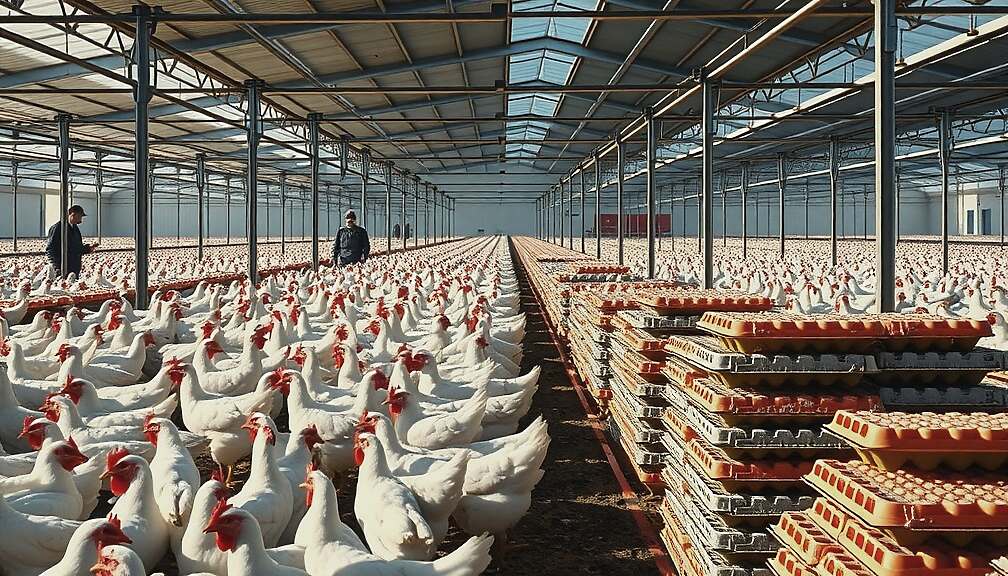
Ground‑breeding (Bodenhaltung) remained the dominant system, accounting for 57.6 % of the eggs. Although slightly lower than the 58.0 % reported for 2024, ground‑breeding still produced the bulk of eggs. The share of free‑range eggs (Freilandhaltung) rose to 24.7 % in 2025, up from 23.6 % in 2024. Organic eggs (ökologische Erzeugung) reached 14.6 %, also a small increase over the 14.1 % recorded in 2024. The remaining 3.1 % of the production came from hens kept in small groups or in specially designed cages (4.3 % in 2024).
Across the recorded farms, 45.2 million hens were kept on average, giving each hen a yearly yield of about 304 eggs.
“Free‑range system”
The average flock size of free‑range hens grew by 5.0 % (an additional 538 000 hens) to 11.2 million. Egg production from this system increased by 5.2 % – 167 million eggs – to a total of 3.4 billion. Slightly less than half of these eggs came from Lower Saxony (45.0 %) and Mecklenburg‑Vorpommern (10.7 %).
“Organic system”
The average number of organic hens rose by 3.3 % – 215 000 more hens – to 6.7 million. Correspondingly, the share of organic eggs grew by 4.1 % – 79 million eggs – to 2.0 billion. More than half of all organic eggs were produced in Lower Saxony (45.3 %) and Bavaria (11.4 %).
“Ground‑breeding”
The average brood of ground‑breeding hens slipped slightly by 0.9 % – 226 000 hens – down to 25.9 million. However, egg production from ground‑breeding remained almost unchanged at 7.9 billion eggs, a marginal decline of 0.2 % (about 17 million eggs). The majority of these eggs (nearly half) originated from Lower Saxony (34.7 %) and North Rhine‑Westphalia (12.8 %).
“Small‑group and caged hens”
As in previous years, the number of hens kept in small groups and in specially designed cages – and the eggs they produced – fell sharply. In 2025, the average number of hens in this category fell by 28.8 % – 562 000 hens – to just under 1.4 million. Egg production from this system also dropped markedly, by 28.0 % (164 million eggs) to 423 million eggs. The steep decline is attributed to Germany’s ban on this type of housing, which came into effect in 2010, although farms that already operated under the system were permitted to continue until the end of 2025.