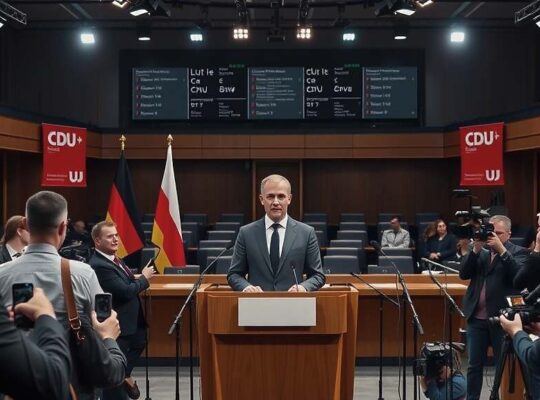
A contentious debate has erupted in Germany regarding the responsibility for the recent decline in asylum seeker numbers, with accusations of political point-scoring dominating the narrative. Interior Minister Alexander Dobrindt of the CSU has claimed credit for the downward trend, asserting that his government’s policies – including stricter border controls, the curtailment of perceived incentives such as accelerated naturalization processes and the restriction of family reunification – have successfully transformed Germany’s migration landscape. Dobrindt declared to the Süddeutsche Zeitung that the nation is no longer acting as a “migration magnet” and that the effective combatting of illegal immigration is yielding results.
However, this assertion has been fiercely challenged by Wolfgang Schmidt, a former key advisor in the preceding “traffic light” coalition government under Chancellor Olaf Scholz. Schmidt contends that the Scholz administration’s policies are the primary drivers of the decreased asylum applications, pointing to internal government projections from April that accurately predicted a figure of under 100,000 asylum requests for the year. These projections, he argues, demonstrate the efficacy of the previous government’s approach. Official statistics from the Federal Office for Migration and Refugees confirm a decrease in first-time asylum applications, totaling approximately 108,000 by mid-December.
While acknowledging the overall reduction in asylum claims – a roughly 50% decline compared to previous years – independent migration researchers are tempering enthusiasm surrounding the political claims. Gerald Knaus, a prominent migration expert, has cautioned against attributing the drop solely to the current government’s actions. Knaus observed that a definitive shift in migration patterns has not become apparent since the current administration took office in May, noting that application rates during the autumn months remained consistent with those observed earlier in the year.
The disagreement highlights a broader political struggle to define responsibility for managing migration flows, with both sides attempting to capitalize on the perceived success in curbing asylum applications for political gain. The debate also glosses over the complex, multifaceted factors – including economic conditions in countries of origin, shifting geopolitical dynamics and international agreements – that likely contribute to fluctuations in asylum seeker numbers, raising questions about the depth of understanding informing the political discourse.