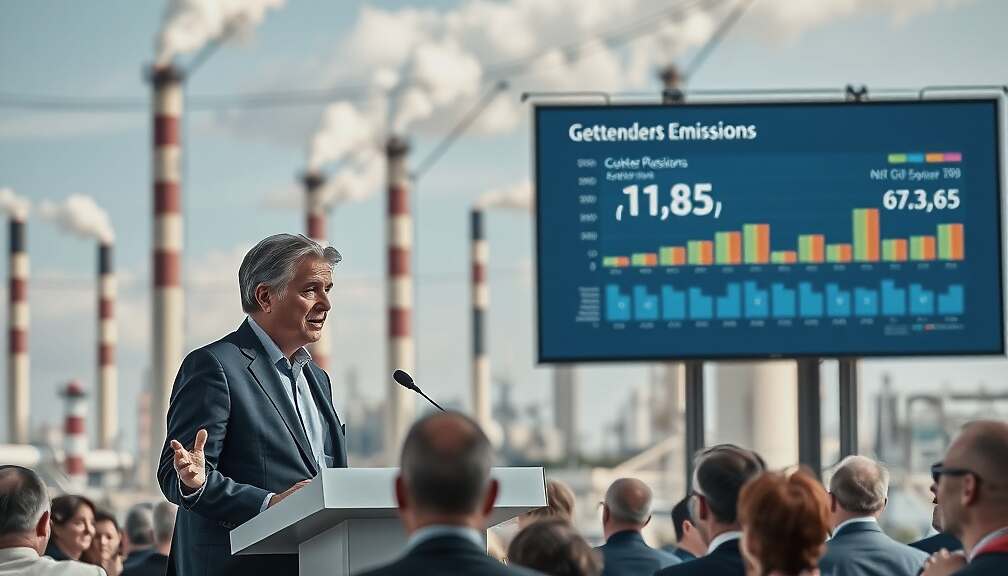
Bundesenvironmentminister Carsten Schneider (SPD) announced that the German chemical industry will receive more free CO₂‑emission certificates than originally planned. Speaking to the “Handelsblatt” (Friday edition), he said he is lobbying in Brussels for more realistic standards for the allocation of free emission rights, adding that the chemical sector is under international pressure and that “we take this seriously”.
Schneider praised the emissions‑trading system, calling it a successful market‑based tool that blends climate protection with economic strength. He stressed that the key will be to shape the framework so that Germany and the rest of Europe can remain strong, innovative hubs for chemical production.
According to his ministry, Schneider has already approached the EU Commission to reach swift solutions. Prior to that, he engaged in discussions with representatives from chemical companies, industry associations, and trade unions. The position now presented to Brussels was jointly developed with the federal government. Its goal is to create an attractive production and investment environment for Germany’s chemical industry and to prevent emission shifts abroad.
The two CO₂‑emission‑trading systems are the EU’s most important climate‑protection tools; they limit how much CO₂ may be emitted in each sector by capping the number of certificates. Beginning this year, the free allocation of permits will be sharply reduced. If a sector receives more free certificates, the pressure on that sector to move quickly toward climate‑friendly solutions diminishes, while pressure on other sectors-such as energy-may rise because the total amount of permitted emissions remains unchanged.
Revenue from the emissions‑trading market flows into Germany’s Climate and Transformation Fund. From that fund, investments are made in renewable energy expansion, electric‑mobility promotion, energy‑efficient building renovation, hydrogen projects, and the shift to climate‑friendly industrial processes. Lower revenue therefore translates into smaller subsidies and grant allocations.