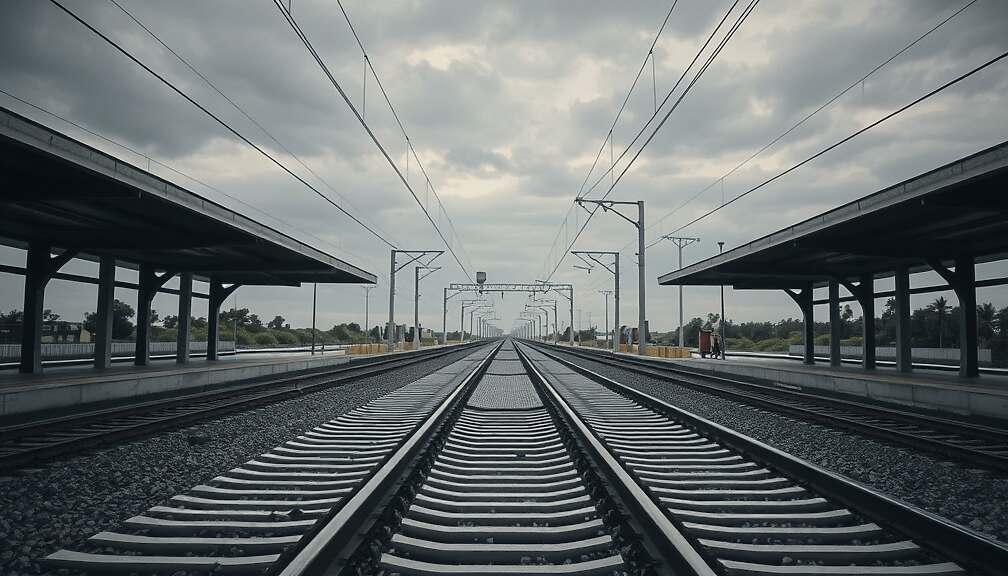
A stark slowdown in the construction of new railway lines in Germany has emerged, revealing a worrying divergence between declared climate policy goals and actual infrastructural investment. Analysis of government infrastructure reports and data from Deutsche Bahn, published by the Frankfurter Allgemeine Sonntagszeitung, demonstrates that only 240 kilometers of long-distance railway lines – predominantly intended for high-speed ICE trains – have been opened since 2016. This stands in stark contrast to the 350 kilometers built between 2006 and 2015 and the even more substantial 500 kilometers completed in the preceding decade.
While the government champions a “Mobility Transition” (Verkehrswende) and repeatedly announces significant investment in rail infrastructure, the reality paints a different picture. The slowdown comes despite a special fund for infrastructure currently boasting a budget exceeding 100 billion euros. The contrast is further amplified by a recent surge in road construction. Approximately 250 kilometers of new highways have been opened since 2016, alongside 363 kilometers expanded with additional lanes. Numerous new federal roads, frequently built with four lanes or serving long-distance traffic with two, have also been completed, suggesting a prioritization of road development despite pledges to favor rail.
Interestingly, the pace of road construction itself has decelerated compared to the decade prior to 2016, with no single year witnessing more than 100 kilometers of new highway or expansion. This follows a period, particularly in the 1970s, when annual completions regularly surpassed 400 kilometers.
Crucially, even with the massive infrastructure fund, a genuine mobility transition based on new construction appears unlikely. Currently, only 140 kilometers of new highway are under construction, dwarfed by the mere third of that distance dedicated to new railway lines. Long-planned vital rail projects, including the Frankfurt-Mannheim, Frankfurt-Fulda and Hannover-Hamburg lines, remain stuck in planning phases, with no construction start date in sight. The Rheintalbahn, a crucial artery for European freight transport, will not receive planned track expansions until 2040.
Responding to inquiries from the Frankfurter Allgemeine Sonntagszeitung, the Ministry of Transport has asserted that increased investment in rail primarily focuses on maintaining the existing network, effectively diverting resources away from desperately needed expansions and new rail infrastructure. This prioritization raises serious questions about the government’s commitment to a genuinely sustainable transport policy and the feasibility of meeting climate targets reliant on a more robust and expanded rail network. The disparity highlights a significant policy disconnect between political ambition and practical action, potentially undermining the long-term viability of Germany’s mobility transition.