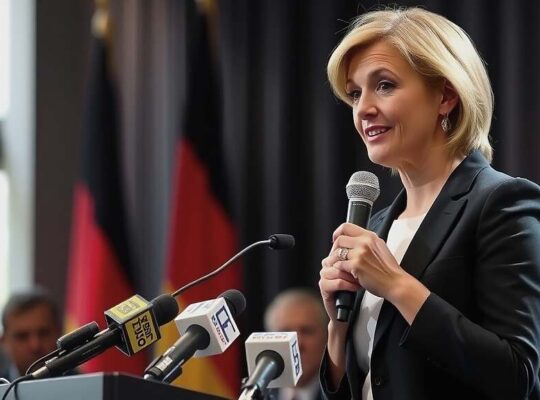
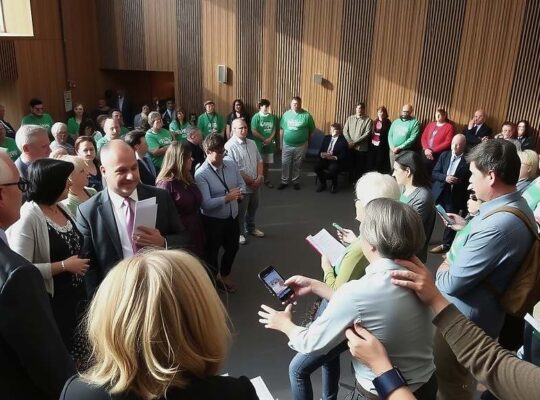
The Green Party’s three-day federal convention concluded Sunday in Hanover, marked by internal debates, critiques of the governing coalition and shifts in policy direction. The final day focused on discussions surrounding taxation and energy policy, alongside a scheduled address from former Agriculture Minister Cem Özdemir, a prominent figure poised to lead the Green’s campaign in Baden-Württemberg’s upcoming state election.
The convention began with a sharp rebuke of the current ‘black-red’ (CDU/SPD) coalition government. Green Party leader Franziska Brantner accused the government of presiding over years of economic stagnation, alongside a widening wealth gap characterized by soaring billionaire fortunes and an alarming rise in child poverty – one in four children now experiencing deprivation. Her co-chair, Felix Banaszak, echoed this sentiment, advocating for a more defined and distinct political profile for the Green Party to differentiate itself within the fragile governing alliance.
Foreign policy also dominated discussion on the second day, resulting in a significant, though carefully worded, realignment regarding the party’s stance on the Israeli-Palestinian conflict. Delegates adopted a resolution emphasizing the importance of Palestinian self-determination, signalling a move towards greater advocacy for Palestinian rights. However, a majority ultimately voted against immediate recognition of Palestine as a state, demonstrating an ongoing tension between ideological convictions and pragmatic political considerations within the party.
The contentious debate surrounding mandatory military service yielded a compromise, albeit one fraught with internal power struggles. The Greens elected to advocate for universal conscription – requiring all young men to register and undergo evaluation – while simultaneously opposing a formal “duty to serve”. This resolution overruled the Green Youth wing, which initially championed a policy entirely devoid of compulsory elements. Conversely, the Green Youth gained traction with a motion pushing for a future return of the Deutschlandticket to its original price of nine euros per month, challenging the party’s executive’s proposal of a forty-nine euro figure, highlighting the ongoing dynamic between established leadership and rising voices within the party. The decisions underscore the complex balancing act faced by the Greens as they navigate Germany’s evolving political landscape.