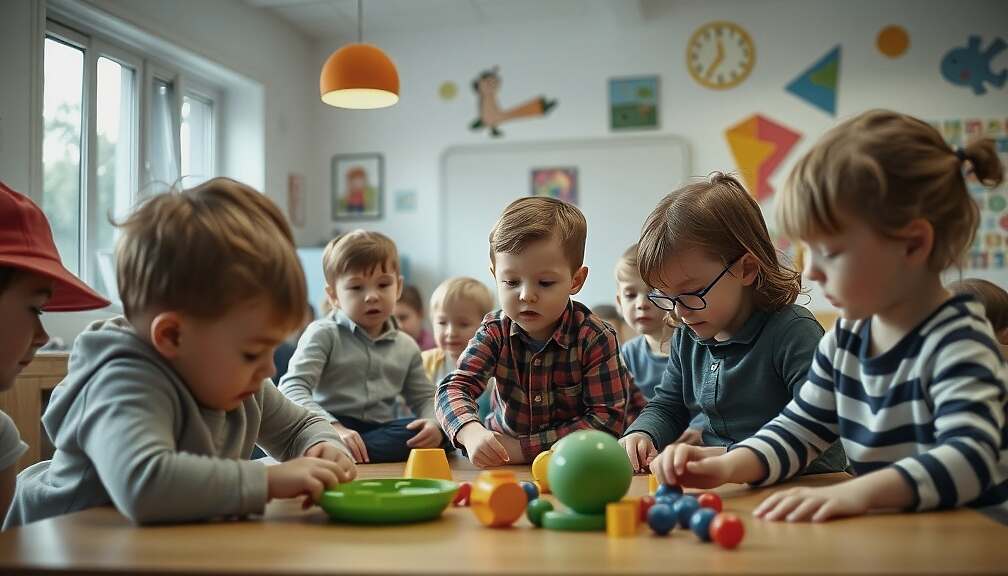
The Green Party is advocating for the introduction of a mandatory, fee-free final year in kindergarten for all children in Germany before they enter primary school. This proposal originates from a new policy paper adopted by the Green parliamentary group in the Bundestag, which was reported by “Die Welt”.
This concept, dubbed the “Startklar-Jahr” (Ready-to-Start Year), must ensure that the necessary educational support is available to every child. Anja Reinalter, Parliamentary Director for the Green Bundestag group, told the newspaper that the Green Party seeks to ensure this compulsory and cost-free year. Furthermore, the party demands that parents be informed about their legal right to daycare enrollment starting at their first birthday and receive support while searching for a placement.
The Green Party’s demands exceed the scope of the planned Starting Opportunities and Quality Development Act (SCQEG), which is expected to be passed next week by Federal Minister for Education, Karin Prien (CDU). The SCQEG is significant because it introduces nationwide, legally binding data collection on the language and developmental status of four-year-olds, followed by targeted support if deficits are identified.
In their position paper, titled “Every Beginning Counts: Creating Starting Opportunities for Our Children with a Kindergarten Quality Covenant,” the Greens call not only for the mandatory pre-school year but also for an indefinite Kindergarten Quality Covenant between the federal and state governments. Under this covenant, the federal government would permanently allocate three billion euros annually. In return, legally binding, uniform quality standards would be established nationwide. The paper stipulates that whoever permanently mandates these quality standards must also permanently fund them, aiming to make the financing independent of temporary federal funds.
This stance goes further than the current federal government’s Kindergarten Law. While the existing law does allocate federal funds for additional tasks, distributed to the states via changes in VAT distribution, these contributions are not permanent. The planned federal participation is set to decline: €1.493 billion annually in 2027 and 2028, €1.243 billion in 2029, and €993 million annually from 2030 to 2034.
During a public hearing on the SCQEG in the Bundestag’s Committee on Education, Families, Seniors, Women, and Youth, experts had warned about the insufficient funding of the proposed reforms. The Greens are thus now demanding a permanent financial commitment.
Reinalter stated that while the CDU/CSU plans to reduce federal funding for kindergarten quality by half and withdraw completely from financing by 2035, the Green Party demands a permanent Kindergarten Quality Covenant providing three billion euros annually from the federal government. Additionally, they demand that the Kindergarten Investment Program from the special reserve fund be increased to eleven billion euros. For Reinalter, good early childhood education requires reliable and continuous funding and adequate daycare placements. She stressed that educational equity cannot begin only in school; since a child’s opportunities in Germany still depend too heavily on their family background, permanent investment must be made early on to change that reality.