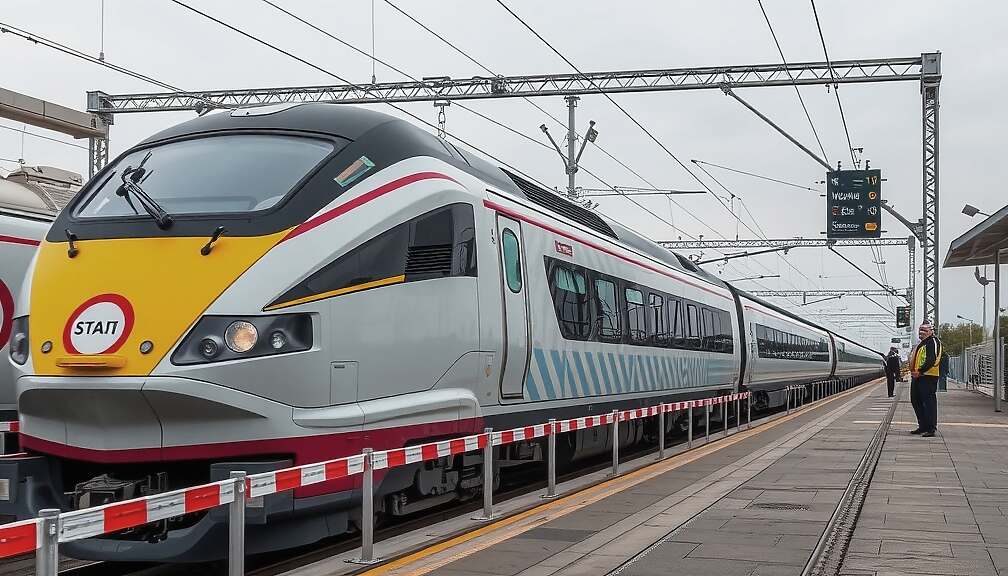
Deutsche Bahn’s long‑distance services on the Hamburg‑Berlin high‑speed line will now be slower than they were before the months‑long closure. According to the Süddeutsche Zeitung’s Sunday edition, the fastest ICE will cover the route in 107 minutes.
The quickest journey had previously taken 103 minutes. Right before the corridor was upgraded, the railway operator added two minutes to the timetable in 2025, bringing the travel time to 105 minutes. Now that the construction work is finished, another two minutes are added, raising the total to 107 minutes. The company initially denied the figures but later conceded them after the newspaper’s inquiries.
Under former chief executive Hartmut Mehdorn, the line was upgraded in the early 2000s from 160 to 230 km/h at a cost of €650 million. The original promise was a 90‑minute trip, but soon it became clear that the target could not be met. The timetable was first extended to 93 minutes and then to 95 minutes.
In 2021, the then‑German government answered a Green‑party inquiry with: “According to Deutsche Bahn AG, the shortest possible journey is 1 hour and 35 minutes”. The duration had increased mainly because of the line’s condition-age, wear, and the resulting construction premiums.
After the renewal, that reason no longer applies. A Deutsche Bahn spokesperson explained that the longer travel time is “not caused by the state of the infrastructure after the corridor renovation, but by a complex system that is used to create the timetable”. According to her, both Hamburg and Berlin stations are overloaded, the network is very busy because of the many regional trains, and the condition of adjacent lines also affects the schedule.
Professor Christian Böttger of the Berlin University of Applied Sciences says these explanations are a pretense. “The ever‑changing excuses from Deutsche Bahn are unsettling” he says. “Now the reason is not that the track is deteriorated, but that it’s overloaded”. He adds that the passengers are disappointed and wishes the railway company of the future would show more honesty.