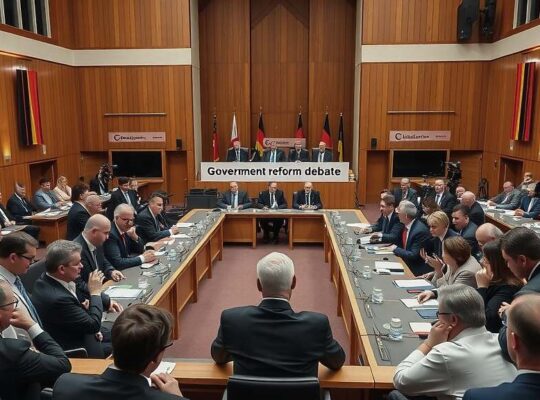
The German government’s recently unveiled plans for a reform of the Building Energy Act (GEG), now rebranded as the Building Modernization Act, have drawn a wave of disappointment and criticism from industry associations and businesses. The lack of clarity and ongoing uncertainty surrounding the legislation continues to plague the heating sector, despite initial commitments outlined in the governing coalition agreement.
The German Heating Industry Association voiced deep concern, stating that a fundamental lack of consensus within the governing coalition persists, despite prior assurances. They characterized the current situation as “consistent with a pattern of hesitant and indecisive decision-making” highlighting a profound lack of planning certainty for companies operating within the sector.
While the Central Association of the Sanitary, Heating and Climate Industry (ZVSHK) cautiously welcomed the introduction of a “binding timeline” – committing coalition parties to defining core elements of a new heating law by early 2026 and swiftly bringing it to cabinet – they emphasized the urgent need for concrete action. They argue the protracted period of ambiguity has demonstrably hampered industrial progress, skilled trades and the overall advancement of climate protection initiatives. A key demand echoed by the ZVSHK is the ability to utilize “all technologies that can function CO2-neutrally in the future” ensuring technological flexibility in achieving climate goals.
Enerix, a renewable energy company, adopted a markedly critical tone. Their spokesperson, Lucas Flügel, dismissed the current plans as superficial, noting that “so far, only the name and the timeline are defined”. Importantly, he stated that the government’s explanations have failed to alleviate societal anxieties regarding mandatory heating system replacements.
Octopus Energy Germany shared this sentiment. Bastian Gierull, CEO, described the heating industry as “shrouded in fog” pointing to a continuing cycle of announcements lacking substantive content. He wryly noted the recent decision to rename the legislation as a particularly symbolic consequence of this ongoing instability.
The existing Building Energy Act mandates that newly installed heating systems incorporate a minimum of 65% renewable energy sources. While the specifics of technology selection remain ostensibly open, the legislation aims to improve the climate footprint of the building sector through financial incentives for CO2-reducing technologies. However, the German Advisory Council on Climate Change, responsible for monitoring compliance with federal climate protection laws, has repeatedly flagged significant further action still required within the building sector to meet national targets. They contend that accelerating emission reductions in this area is crucial to mitigating energy costs for consumers across Germany and the wider European Union, minimizing the resulting social burden.