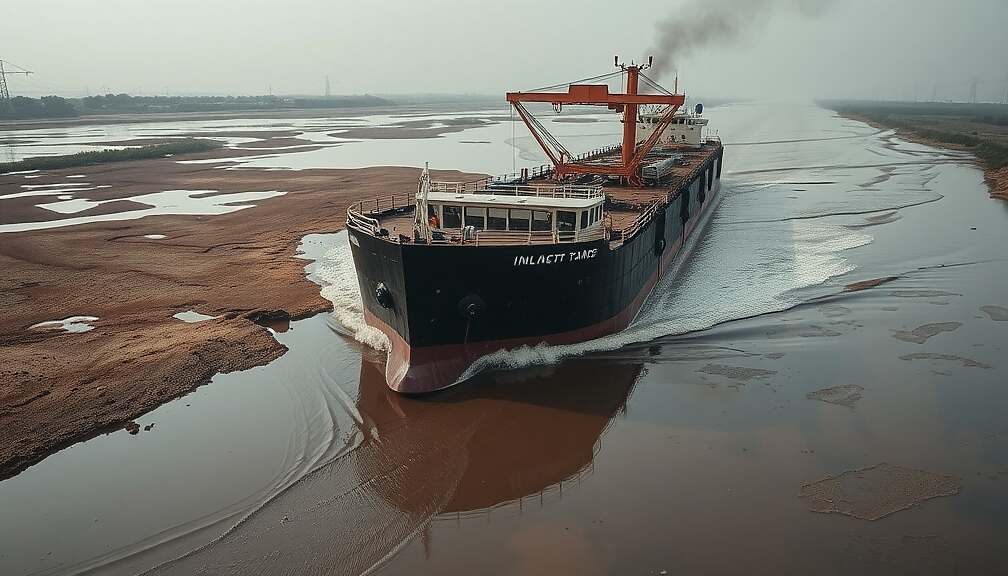
The Federal Association of German Inland Shipping (BDB) is urgently calling on the Federal Transport Ministry to implement faster measures to combat low water levels. According to BDB CEO Jens Schwanen, speaking to the “Rheinische Post,” recent coordination meetings within the ministry made it clear that inland shipping vessels cannot simply be replaced. Schwanen warned that neither the railway nor truck freight companies can currently provide sufficient capacity to transport goods from ships without significant limitations.
The association is pressing for three essential actions. “We propose a three-point plan: Firstly, it is crucial from our perspective that the Federal Transport Ministry continues the funding for low-water-optimized ships starting in January and does not let it expire as planned,” Schwanen demanded. He explained that Germany currently possesses only twelve such vessels, and they are not readily available for general use.
Secondly, the navigation channels on the Middle and Lower Rhine must be expanded at the fastest possible pace. This expansion would bring an additional 20 centimeters more water below the keel. Schwanen stressed that 2033 as a target date is far too late given the coming summers. Thirdly, the relevant authorities within the Federal Transport Ministry must rapidly find ways to retain more water in the Rhine. “Currently, water rushes unstoppably toward the Netherlands from Iffezheim Lock,” Schwanen said. “When it doesn’t rain for eight weeks, the current low water levels occur. Ideas must be developed to keep the water in the river longer.”
He added that this is not solely an issue for the shipping industry or manufacturing sector, but a matter for society as a whole. Mass fish deaths, dried-up meadows, high water temperatures, and a lack of oxygen are pushing the Rhine’s habitat to its limits, affecting everyone.