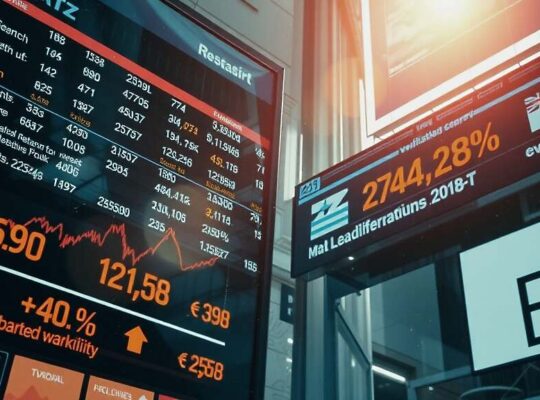
The German index, the Dax, opened the trading day on Monday with losses. At approximately 9:30 AM, the leading index was calculated at roughly 23,855 points, representing a drop of 0.4 percent from Friday’s closing level. The stock companies leading the board included Rheinmetall, SAP, and Infineon, while the last group noted were Heidelberg Materials, Vonovia, and MTU.
Market specialists suggested that concerns over a renewed escalation in the Middle East are unsettling the exchanges. According to Thomas Altmann of QC Partners, the combination of new threats from Donald Trump is causing markets to react in their usual manner: oil prices and interest rates are rising, leading to a decline in risk assets like stocks.
Altmann warned that this crisis is becoming increasingly large and dangerous for the global economy. He pointed out that companies face an immense double burden due to higher energy and capital costs, noting that every such factor has the potential to inflict deep damage.
In terms of monetary policy, markets seem to have abandoned hopes for falling key interest rates. Instead, Altmann noted that Fed President Kevin Warsh is facing a difficult first test. He stated that the exchanges currently price in a 70 percent probability of an interest rate hike by the Fed this year, while three rate increases are already factored into expectations for the ECB.
In other markets, the European common currency was slightly stronger on Monday morning, with the Euro costing 1.1637 US Dollars, and the Dollar available for 0.8593 Euros. Meanwhile, oil prices saw a significant increase. By 9 AM Central European Time, a barrel of Brent crude oil cost $111.00, marking a 1.6 percent increase from the previous day’s closing figures.