

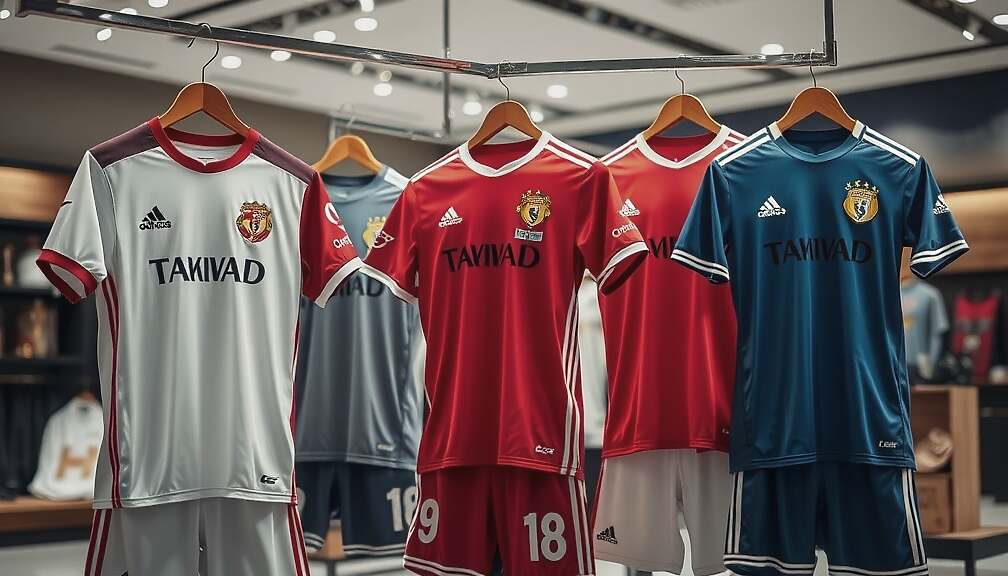
Jako, the German sports manufacturer, has defended the high price points of its soccer jerseys. Tobias Röschl, a board member at Jako, told media outlets that if customers are willing to pay the price, it is justified.
Röschl pointed out that the revenue generated by these items does not solely remain with the equipment providers, especially referencing current national jerseys. For instance, Jako, as the supplier for the Iraqi national team, is participating on the world stage at the 2026 World Cup. The jersey for this participant is currently priced at 85 euros, which is lower than the minimum 100 euros demanded by fans for the German national team’s Adidas jersey. Röschl maintained the price structure generally, explaining that distributors and governing bodies also profit from sales. He emphasized that by purchasing an original jersey, customers are contributing to beneficial causes, as these funds are used to finance structures in youth and amateur football.
The debate over jersey pricing was recently heated when Stephan Mayer, an CSU Member of the Bundestag, demanded that children’s jerseys be offered at significantly cheaper rates to ease the financial burden on families. Röschl rejected such demands, stating that it is not the role of politicians to demand low prices. Instead, he advised that politics should focus more heavily on protecting legitimate commerce from online platforms like Temu or Shein.
Regarding manufacturing, Röschl believes that producing jerseys in Germany would not lower the prices. He explained that their Asian manufacturing partners benefit from established supply and raw material chains and maintain high quality standards, adding, “The product would not become cheaper through such a step.”
Addressing the broader economic climate, Röschl noted that many retailers are facing a difficult environment due to consumer reticence and declining foot traffic in city centers. Despite these pressures, Jako itself has seen strong growth in recent years, surpassing 200 million euros in revenue for the first time. Although this growth is beginning to stabilize-partially because the company asserts it is a market leader in team sports in the German-speaking region-Jako is now focusing on new business areas. Alongside soccer shoes, which are produced in Portugal, the company plans to offer more workwear and team apparel for various businesses, ranging from industrial companies to physiotherapy practices. Local sporting retailers are intended to be integrated as sales partners in this expansion.
Jako, headquartered in Mulfingen, Baden-Württemberg, was founded in 1989 and is considered one of the leading team sport manufacturers in the German-speaking area. The company supplies numerous clubs and associations and has a strong presence in amateur and recreational sports. Furthermore, Jako is equipping the Iraqi national team for the 2026 World Cup.