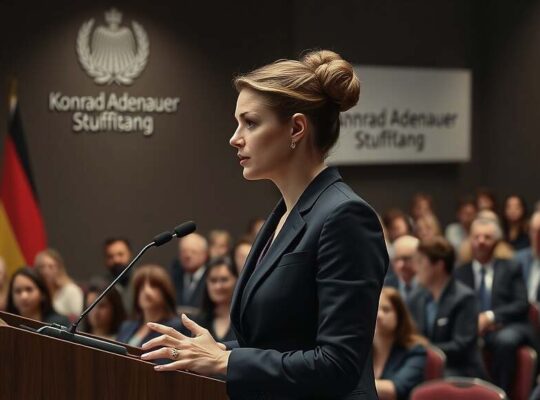
Annegret Kramp-Karrenbauer, the former leader of the Christian Democratic Union (CDU), has staunchly defended her contested victory for the chairmanship of the Konrad Adenauer Foundation (KAS), framing the outcome as a testament to democratic process rather than a sign of internal party discord. In an interview with ARD’s “Interview der Woche” Kramp-Karrenbauer acknowledged prior instances where preferred candidates, notably Annette Schavan under the guidance of former Chancellor Angela Merkel, were unsuccessful, but differentiated her own election by the fact Schavan withdrew prior to a decisive vote. This allowed her to confront and ultimately defeat the candidacy of Günter Krings, the preferred choice of current CDU leader Friedrich Merz, in a formal contest.
The contested election, occurring within a crucial think tank closely aligned with the CDU, has sparked debate about the internal dynamics of the party and the extent to which favored candidates can influence selections. While Kramp-Karrenbauer emphasized members’ satisfaction at having the opportunity to compare candidates directly, critics suggest the public nature of the contest, particularly given the opposition to Merz’s preferred candidate, highlights underlying tensions within the CDU’s factions.
Looking ahead, Kramp-Karrenbauer identified key priorities for the KAS, centering on strengthening Western ties, reinforcing the transatlantic partnership and safeguarding democratic values. She signaled the foundation’s commitment to expanding its efforts in promoting democracy, specifically targeting rural areas, underscoring a recognition of the disparities in access to democratic engagement across Germany.
Despite the renewed prominence, Kramp-Karrenbauer characterized the KAS chairmanship not as a springboard back into frontline politics, but as an opportunity for continued political engagement operating outside the immediate demands of governmental leadership. She expressed gratitude for the position, framing it as a suitable role for a seasoned political figure nearing the conclusion of their career, while implicitly distancing herself from a potential return to the turbulence of day-to-day political operations. The appointment, however, will inevitably be scrutinized as a barometer of Kramp-Karrenbauer’s ongoing influence within the CDU and her perspectives on the direction of German politics.