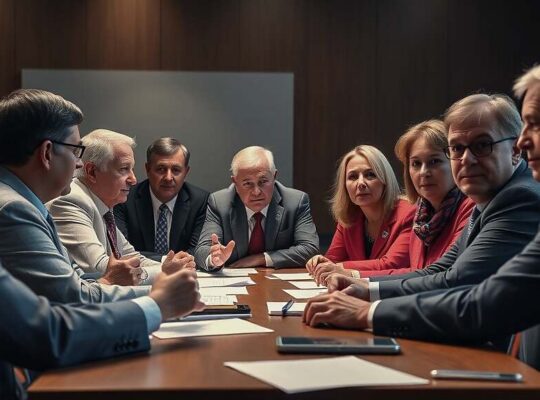
Wolfgang Kubicki, the deputy chair of the FDP, has set a strong trajectory for the party, aiming to achieve election results of ten percent or higher. Speaking to “Bild am Sonntag”, he reiterated that his goal is to bring the FDP back into the double digits. Such an achievement was realized in 2017 (10.7 percent) and again in 2021 (11.4 percent), suggesting that aiming for less is “quite unambitious”. Kubicki had previously announced his intention to run for the party chairmanship in May.
Regarding his commitment, Kubicki addressed the question of his changing perspective, particularly since stating in February 2025 that he knew he was not the definitive future of the party following its electoral disappointment. He now asserts that he believes the party requires a clear pathway forward. Currently, the FDP is not represented in the Bundestag and has fallen below a level of public visibility. Kubicki expressed profound frustration at constantly observing that the party is no longer even listed in public opinion polls. Given that he has been involved with the party for 56 years, he feels he cannot stand by and watch it decline.
When asked how a Kubicki-led FDP would differ from a Lindner-led one, Kubicki deflected, stating that it will be neither a Lindner FDP nor a Kubicki FDP. He dismissed the idea that the mere presence of a dedicated leader would fix everything. According to him, the FDP possesses a clear policy proposal that has become critically relevant in the current climate. While all parties advocate for preserving prosperity, their actual policies tend to undermine it. The Free Democrats, he argued, have an incredibly strong political offering-they simply need a face capable of conveying it.
Kubicki identified the loss of economic wellbeing as the most urgent national crisis. He pointed to the annual loss of between 120,000 and 150,000 industrial jobs, the highest wave of insolvencies in a long time, and the trend toward increased taxes everywhere without corresponding savings. He dismissed earmarked special funds as essentially debt, and cost-cutting measures as nothing more than tax hikes.
He criticized incumbent Chancellor Friedrich Merz (CDU), stating that while he had known and supported Merz for a long time, he now feels that everything appears to be fabricated. Kubicki observed that Merz gives wonderful speeches to various associations, but his practical politics the following day are often the exact opposite. Furthermore, he criticized Finance Minister Lars Klingbeil (SPD), arguing that the SPD minister lacked competence in financial policy, claiming that Klingbeil had never actually managed finance before. While complimenting Klingbeil on being a charming speaker who can play the ukulele, Kubicki sarcastically suggested that appointing someone who has no financial policy experience as the greatest finance minister was a ridiculous notion.
Addressing the concept of a “brand wall” against the AfD, Kubicki stated that he only knows about walls in buildings; he knows of neither a constitutional nor a legislative one. He labeled the concept as a mere invention designed to exclude the AfD. He supported clear boundaries but rejected exclusion, adding that such measures would benefit the AfD more than harm it.
Regarding the timing and outcome of the next federal election, Kubicki speculated that the CDU and SPD would likely remain allied, regardless of the circumstances. He predicted that the public would endure this coalition maneuvering for some time, suggesting that underlying tensions between the SPD and CDU might eventually become so great that their coalition could simply collapse. He concluded by reiterating his overarching objective: returning the FDP to double-digit polling numbers.