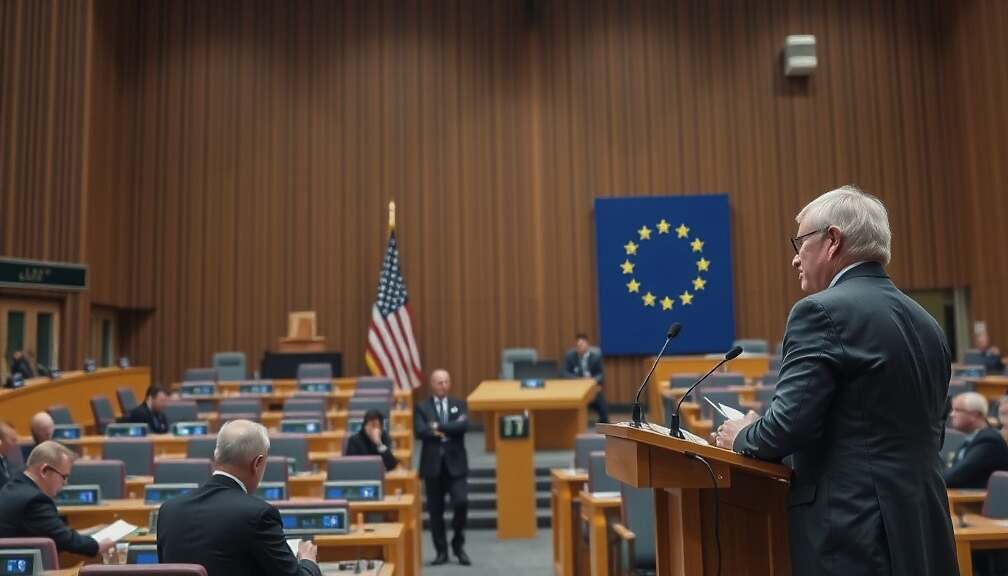
The chair of the European Parliament’s Committee on Trade, Bernd Lange (SPD), has made the ratification of the proposed trade deal with the United States contingent on Washington providing firm guarantees that the agreed tariff rates will not be exceeded. He told the “Spiegel” that on Monday the committee will discuss whether, in light of recent developments, it is still possible to agree on the planned reduction of tariffs for US products. Lange admitted that there is presently “no certainty at all” that the US side will honour the deal, and suggested the EU might have to pause and wait for legal certainty.
The agreement between EU Commission President Ursula von der Leyen and President Donald Trump was signed in the summer during a meeting in Turnberry, Scotland. Lange warned that new tariff announcements break the Turnberry pact. Trump’s initial announcement of a 10 % tariff would add to existing duties, potentially pushing the total tariff burden for many products above the 15 % ceiling agreed in Scotland. The problem would worsen if Trump instead demands 15 %-the maximum rather than the 10 % he initially cited.
“We need a clear legal rule from the United States” Lange said. Washington could define exemptions within global tariffs that would satisfy the agreement, but until that happens there is “absolute chaos” and many questions that must be resolved. He also demanded a stable, reliable commitment from the US that tariffs would not rise again, otherwise the EU will halt its further actions on the deal.
The Committee is to vote on Tuesday over EU concessions, chiefly the complete elimination of many tariffs that currently apply to US agricultural and industrial exports into the EU.
Metin Hakverdi, Germany’s Transatlantic coordinator (SPD), viewed the Supreme Court ruling as an internal political blow to Trump ahead of a crucial election year. He noted that Republicans, even in the deep South where he was visiting, increasingly oppose this tariff policy. The newly announced tariffs may only be temporary, which would diminish the US’s key trade‑policy tool, Hakverdi said. He, like the German chancellor, will closely coordinate the European response, stressing that European unity is now critical.