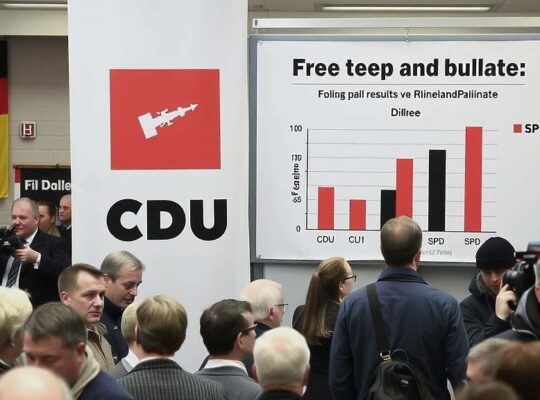
The latest ZDF Politbarometer, released Friday morning, reveals a significant shift in Germany’s political landscape, with the Left Party experiencing a notable resurgence while support for the far-right Alternative for Germany (AfD) declines. The Left Party’s standing has improved by two percentage points since late November, now holding 11 percent – a peak not seen in the Politbarometer’s historical data. This upward trend signals a potential realignment of voter preferences, potentially fueled by growing anxieties over social inequality and economic instability.
The survey also indicates a slowdown in the AfD’s momentum. The party has lost two points, dropping to 25 percent, which places them marginally behind the Christian Democratic Union/Christian Social Union (CDU/CSU). The CDU/CSU, meanwhile, have lost one point, securing 26 percent and reclaiming the position of largest political force. While this represents a relatively small margin, it highlights the challenges facing the AfD in maintaining its rapid ascent, potentially revealing vulnerabilities in their messaging and appeal.
The Social Democratic Party (SPD) remains stagnant at 14 percent, while the Green Party also shows no movement, holding steady at 12 percent. Other parties collectively gained one point, accumulating 12 percent – suggesting a broader dispersal of support across the political spectrum.
Analysts suggest that the Left Party’s gains could stem from a deliberate effort to connect with voters feeling disenfranchised by mainstream political agendas. However, the fragility of their position remains a point of contention, given the party’s historical struggles with internal cohesion and questions surrounding their policy proposals. The CDU/CSU’s regained lead, though small, signals a renewed emphasis on traditional conservative policies. However, they will need to address the underlying anxieties that fueled the AfD’s previous growth to truly consolidate their position and prevent a future resurgence. The results underscore the volatility of German politics and highlight the ongoing struggle for voter loyalty in a period of economic uncertainty and social change.