The leader of Germany’s Left Party (Die Linke), Jan van Aken, has revealed a complex personal history shaped by a childhood steeped in Catholic tradition, a subsequent disillusionment and a renewed appreciation for elements within the Church’s humanitarian efforts. In an interview with the “Rheinische Post”, van Aken described his upbringing as heavily influenced by his mother, a devout Catholic who instilled in him a strong sense of neighborly love – a core tenet of Christian faith.
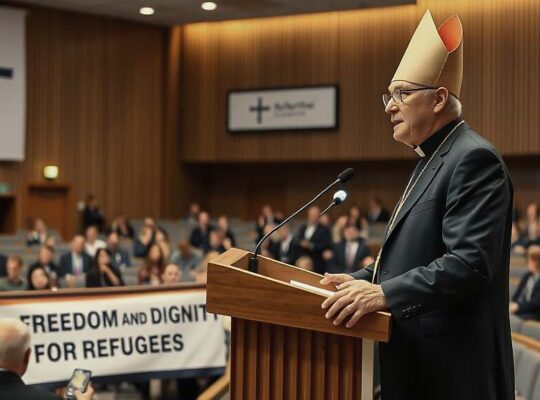
Van Aken acknowledged that his early socialization was profoundly shaped by his mother’s unwavering piety and his own experiences as an altar server. However, he recounted a period of estrangement from the Church during his adolescence, a phase characterized by a questioning of established dogma. A pivotal moment arrived during a Greenpeace mission in the Philippines, where local clergy provided crucial support, prompting a reassessment of the institution’s potential for good.
Despite this renewed, albeit qualified, respect, van Aken indicated he is unlikely to rejoin the Church. He articulated a belief in a potentially higher power, emphasizing a fundamentally different conception of faith than the one held by his mother. This nuanced perspective, publicly shared for the first time, provides a window into the internal moral compass of a key figure in German politics and it also subtly underscores the ongoing tension between secular progressive ideologies and traditional religious values within German society.
Political analysts suggest van Aken’s willingness to discuss his religious background and particularly his divergence from his mother’s faith, could be strategically aimed at softening the Left Party’s often perceived image as anti-religious and further broadening its appeal to centrist voters. His comments could also be interpreted by some as a veiled critique of the perceived rigidity and shortcomings of institutionalized religion. The ability to articulate personal values while maintaining a progressive political stance remains a key challenge for leaders seeking to bridge divides within increasingly polarized societies.