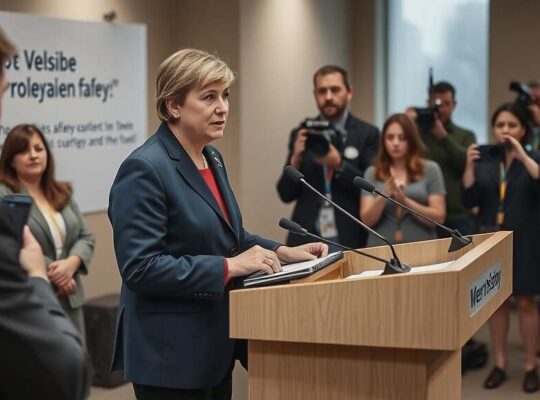
The proposal to decouple the German retirement age from chronological age and instead link it to years of contributions is drawing sharp criticism from leading economists, raising concerns about escalating inequality and potential political gridlock. Marcel Fratzscher, president of the prestigious German Institute for Economic Research (DIW), has publicly denounced the concept as fundamentally unjust, arguing that it risks exacerbating existing societal divisions.
Fratzscher’s assessment directly challenges the recent endorsement of the idea by economist Jens Südekum, who also serves as an advisor to Finance Minister Lars Klingbeil of the Social Democratic Party (SPD). Südekum’s suggestion, aimed at addressing concerns about retirement security, has instead triggered alarm within the economic community.
The core of Fratzscher’s critique revolves around the potential for a regressive impact. He warns that linking retirement to contribution years will disproportionately benefit wealthier individuals, particularly men in traditionally high-paying industrial sectors, mirroring the unintended consequences observed with the earlier introduction of a retirement option at age 63. This existing policy, he noted, largely favored male industrial workers.
Furthermore, Fratzscher contends that the proposed shift will fail to alleviate the growing problem of old-age poverty. Instead, it risks amplifying existing inequalities by penalizing individuals, particularly women, who have spent significant portions of their lives engaged in unpaid work such as volunteering or childcare. This demographic often possesses fewer years of formal employment and contributions, thus detrimentally impacting their retirement prospects under the suggested system.
The debate underscores a deeper ideological fault line within the governing coalition. While proponents argue for greater flexibility and potential cost savings, critics like Fratzscher fear a return to a system where political expediency overrides principles of fairness and social justice. The prospect of protracted political battles over the justification of varying retirement ages appears increasingly likely, potentially diverting attention from more comprehensive solutions to address the complex challenges of Germany’s aging population and evolving labor market. The controversy casts doubt on the feasibility of the reform and highlights the delicate balance required to navigate fiscal responsibility and social equity in a rapidly changing economic landscape.