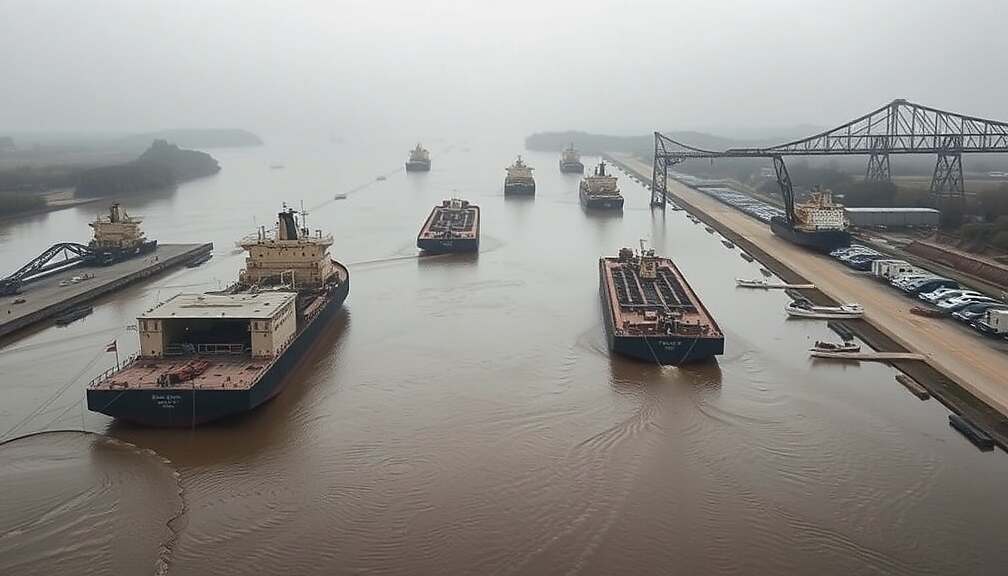
Due to low water levels on the Rhine, production cuts are now occurring. The Institute of the German Economy (IW) anticipates that basic materials industries will be forced to reduce their output.
Thomas Puls, a transport expert at the IW, told the Rheinische Post that south of Kaub, there is a threat of completely severed transport routes, leading to a bifurcation of the Rhine. Given that neither road nor rail infrastructure can accommodate the volume of necessary goods, the most probable response from basic materials industries will be a reduction in production. North of the bottleneck near Kaub, however, the challenge is that ships simply cannot carry as much cargo.
The chemical concern Covestro has already reported limitations. A spokesperson informed the editorial team that the supply of raw materials and finished goods is currently significantly restricted due to the critical low water situation. This restriction is already impacting the raw material supply and the production of individual facilities, as well as the delivery of specific products.
According to Covestro, lifting the Sunday truck driving ban does not offer much help. While suspending the vehicle ban might provide some short-term relief, the spokesperson explained that shipping transported via the Rhine cannot practically be compensated for by road transport. This is because a inland vessel with a capacity of 1,500 tons can replace approximately 60 trucks, meaning the volume of water transport cannot be fully shifted onto the road network.