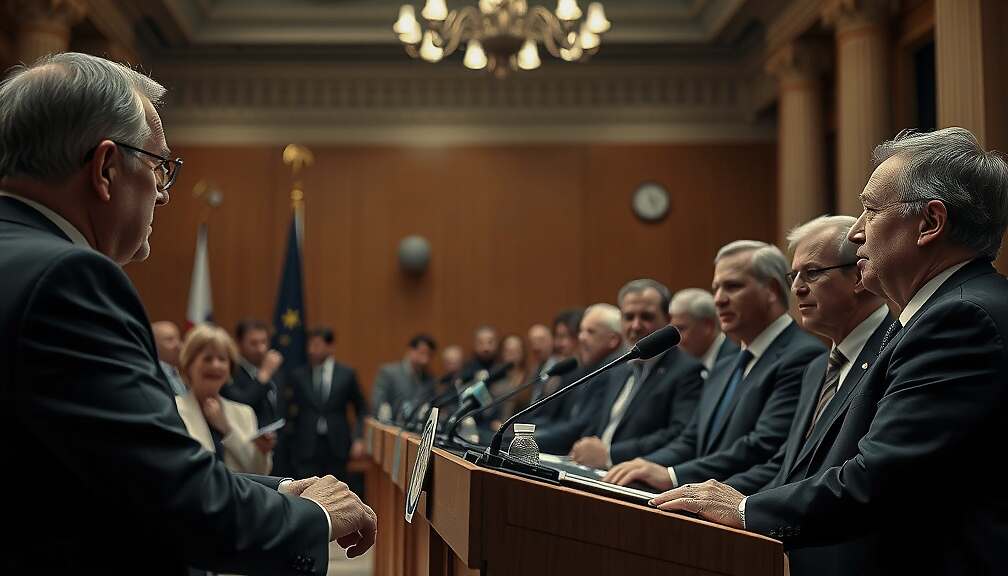
During the traditional summer press conference in Berlin, Chancellor Friedrich Merz (CDU) provided an overview of the first half of 2026, describing a positive performance while also outlining the roadmap for the latter half of the year. He cited the passing of the Investment Future Act, designed to accelerate infrastructural projects, and the comprehensive reform of the statutory health insurance as key domestic achievements. However, Merz cautioned that these steps alone are insufficient to restore Germany’s competitiveness.
Shifting focus to larger projects, he announced that the restructuring of old-age security, which will involve a capital-backed element in the statutory pension system, is set to begin this autumn. While acknowledging that the promised economic turnaround will take longer than anticipated, Merz attributed this delay partly to external factors, such as American customs policies and currency distortions like an undervalued Yuan, stressing the government’s dependence on the global economy.
Addressing criticism regarding rising social contributions and the lack of financial relief for workers, he firmly stated that the government is fighting vigorously against any further increase in contributions. Future reforms, such as those concerning long-term care insurance, still need to be developed, and the coalition must also carefully navigate the proposed reduction of benefits for single parents to ensure children are not negatively impacted.
In foreign and security policy, Merz reaffirmed Germany’s commitment to a stronger role within Europe and the NATO alliance. He emphasized that bolstering defense capabilities is a priority, citing the joint submarine program with Norway and Canada as an example. While taking Russia’s hybrid threats seriously, he maintained confidence in the NATO deterrence mechanism. Furthermore, he confirmed that the planned deployment of US mid-range missiles in Germany, under national control, aligns with existing command and control structures. He also defended the proposal for Ukraine to achieve associate EU membership as a vital way to maintain credibility regarding its potential accession.
When questioned about public dissatisfaction with his policies and poor polling numbers, Merz admitted that these issues are “occupying” him. He noted that the coalition’s work is not yet sufficiently communicated to the public and warned that the upcoming state elections will be a crucial test. Meanwhile, he strongly rejected any participation by the AfD in the government, committing himself to preventing such a scenario.
Regarding structural changes, he described achieving a constitutional change to reform the debt brake as nearly impossible within the current term due to a lack of necessary majorities. Responding to critiques about the lack of female representation in the coalition committee, Merz stated that the appointments are functional rather than gender-based. Finally, he indicated that the succession of ECB President Christine Lagarde is not currently a topic of discussion.
On Wednesday, the press conference hosted around 130 journalists, granting the Chancellor 90 minutes of uninterrupted time for the capital’s press corps.