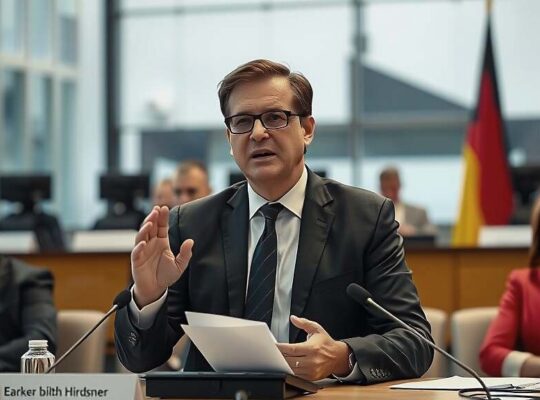
During his visit to Dublin, Chancellor Friedrich Merz (CDU) reinforced his demands for significant reductions to the European Union’s planned Multiannual Financial Framework (MFR). After meeting with Irish Prime Minister Micheál Martin, whose nation holds the EU Council presidency since early July, Merz stated that Germany could not support the EU Commission’s current budget proposal.
The Chancellor called for savings amounting to several hundred billion euros. He argued that given the ongoing budget consolidation efforts by member states, sharp spending increases at the EU level were unjustifiable. Furthermore, Merz criticized the EU Commission’s plans to create additional positions within European institutions. Instead, he proposed drastically cutting bureaucracy and reorienting the budget toward boosting competitiveness, defense, and investment.
Merz remained cautious regarding potential new EU own resources. Germany opposes additional corporate taxation at the European level. While a possible digital tax is open to future discussion, he emphasized that no concrete decisions have been made on this matter yet.
A central theme of the discussions in Dublin was European competitiveness, a topic Merz has been pushing for months. He urged for faster approval and investment procedures, along with the consistent implementation of digitalization, energy, and decarbonization projects. Merz emphasized that Europe must become economically stronger to effectively tackle challenges posed by the Russian invasion, international trade conflicts, and the energy crisis.
Looking at regional integration, Merz and Martin agreed on the necessity of accelerating Montenegro’s accession process, asserting that the country largely meets the preconditions and should not be held back for political reasons. Furthermore, they stressed the need for further progress by Ukraine, Moldova, and the Balkan states aiming for EU membership.
Regarding the war in Ukraine, both leaders reaffirmed their support for the country. Martin referenced his recent trip to Ukraine, stressing that Europe must continue supporting Ukraine on its path toward a just peace. However, Ireland appears somewhat more reserved than Merz regarding his proposal to use “associated membership” as an intermediate step for Ukraine. Instead, Martin stressed the goal of opening “all clusters” to both Ukraine and the Republic of Moldova.
In Middle Eastern policy, Merz defended Germany’s stance against comprehensive sanctions against Israel. While Germany supports measures against products originating in Israeli settlements in the West Bank and criticizes settlement construction, Merz believes there is no basis for general sanctions against Israel due to Germany’s unique historical responsibility.