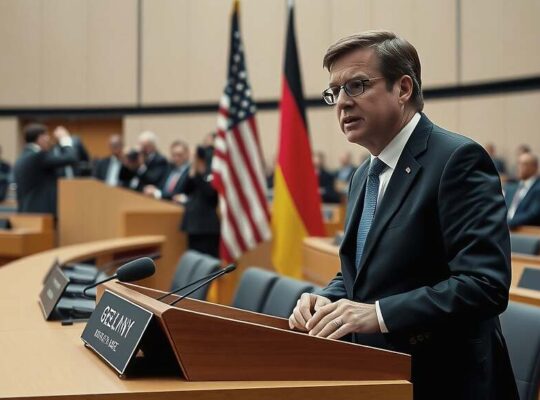
Chancellor Friedrich Merz of the Christian Democratic Union (CDU) has signaled a shift in Germany’s approach to the Ukraine conflict, emphasizing the urgency of a negotiated settlement while simultaneously raising concerns about the potential costs associated with securing a lasting peace. In a government statement delivered to the Bundestag ahead of the upcoming European Council meeting, Merz asserted a growing diplomatic consensus between Kyiv, the United States and European nations regarding the need for a ceasefire and a balanced peace plan.
Merz forcefully defended his government against accusations of insufficient diplomatic engagement, stating that “more diplomacy than in the last days and hours from Berlin is simply not possible”. While expressing a desire for a swift cessation of hostilities, he cautioned that “we must also speak of the price of peace”. This implicitly refers to the complex and potentially costly security guarantees Germany and other European nations may be asked to provide to Ukraine following a ceasefire. While specifics remain vague, Merz indicated discussions concerning Germany’s contribution to these guarantees would be viable once diplomatic processes advance toward a resolution.
The Chancellor also reiterated his support for utilizing frozen Russian assets held in Europe to bolster Ukraine’s military capabilities. He argued that solely targeting Russia’s revenue streams is insufficient to compel a serious engagement in genuine negotiations. “Obviously, the pressure on Putin must continue to rise to move him to serious talks” Merz stated, highlighting a strategy intended to escalate pressure on the Kremlin.
Reflecting on the trajectory of the past year, Merz delivered a sobering assessment of the global landscape, citing the ongoing Ukraine war, a resurgence of protectionism and a perceptible erosion of traditional alliances. “We are moving into a time when the former world order is increasingly becoming a world disorder” he declared, underscoring a growing anxiety within German political circles. He strongly cautioned against Germany being manipulated as a pawn by major global powers, warning of the potential for becoming a victim of these destabilizing processes.
Merz identified two crucial strategic imperatives for the European Union: bolstering Europe’s defense capabilities and restoring the competitiveness of its economy. These actions, he argued, represent the necessary responses to the escalating global challenges. His call for a concerted, cross-coalition effort within both the German government and the broader EU framework exposes a sense of urgency surrounding Europe’s place in a rapidly evolving and increasingly precarious international order. The speech implicitly acknowledges a growing need for greater European autonomy and resilience in a context of shifting geopolitical realities.