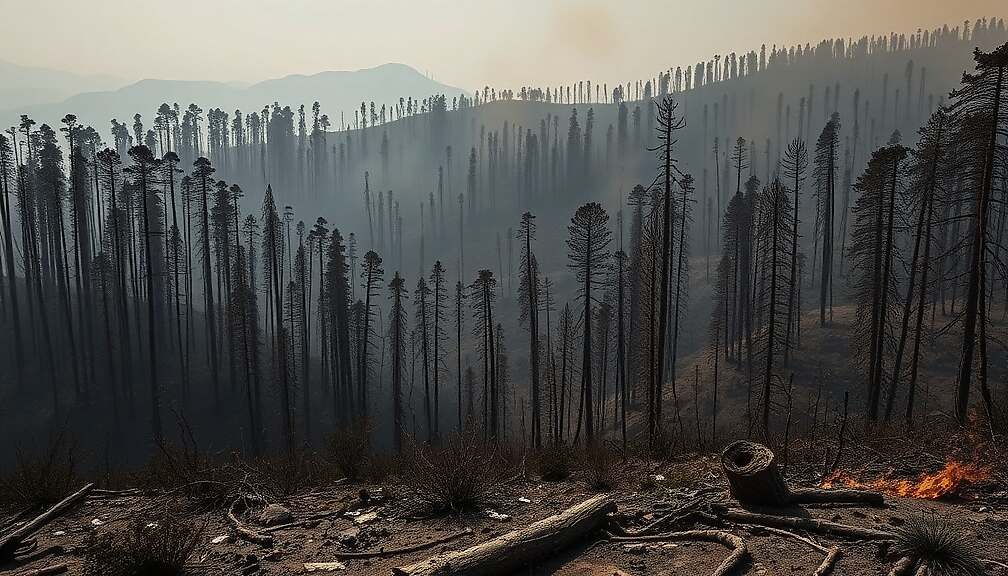
Forestry expert and author Peter Wohlleben advocates for allowing areas damaged by recent wildfires to recover naturally, assuring that “Nature can manage it; I am confident. It has its own emergency program.” Speaking to the “Rheinische Post” on Wednesday, he strongly advised that these areas simply be left undisturbed.
In Wohlleben’s view, the worst course of action would be to “roll the ground flat with machines or clear the forest.” Such interventions would eliminate the remaining humus and compact the soil, exposing it to even more heat and dryness.
During August alone, 300 hectares burned in the Hürtgenwald and around 3,000 hectares burned in the Hohen Venn. According to Wohlleben, these areas do not necessarily need immediate replanting. “I estimate that in the Hürtgenwald, the first small trees may grow back within one to two years. We will certainly see green shoots as early as next summer.”
Should future planting become necessary, he insists that only native deciduous forests must be planted. Wohlleben noted that it “rarely happens in nature for native deciduous forests to burn completely down to the canopy.” Instead, fires usually occur in logged areas or areas planted with non-native conifers. He warned specifically against planting native needle-bearing species such as spruce, pine, or Douglas fir, stating, “By doing that, we are laying the groundwork for tomorrow’s forest fires.”
Wohlleben, who is a qualified forester, has authored several books on trees and the forest ecosystem, and his work, “The Secret Life of Trees”, was adapted into a film in 2020.
The text also provided wider context regarding the relationship between wildfires and climate change. It is difficult to make definitive statements about this link because reliable data on forest fires is limited in many global regions, and other factors-such as forest management practices and intentional arson-play a role. However, periods of high fire risk, known as “fire weather,” have increased across all continents. In South Europe, northern Eurasia, the United States, and Australia, the rise in fire probability and the total burned area can be clearly attributed to global warming, which is driven by the release of additional greenhouse gases through the burning of coal, oil, and gas.