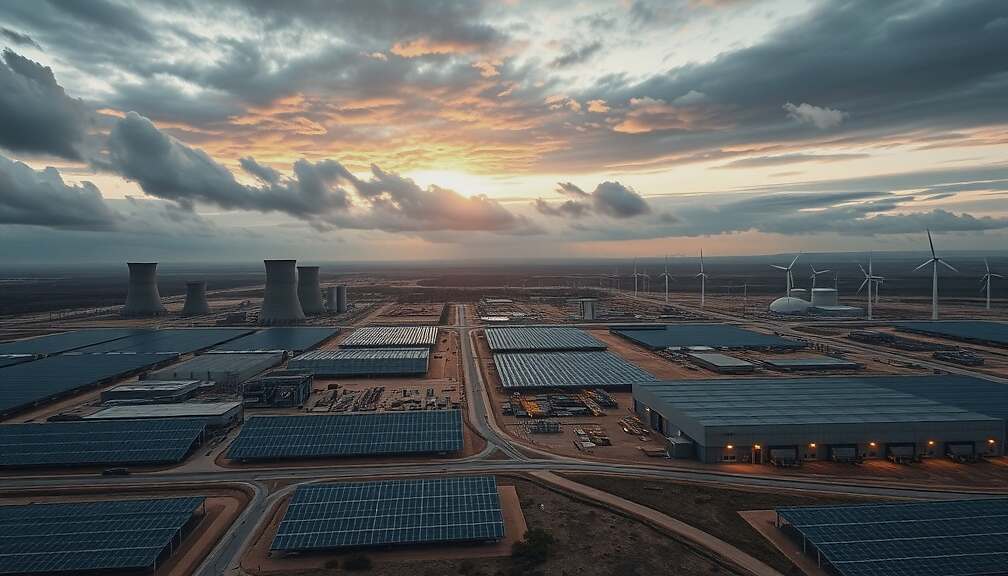
According to a new study conducted by the Eco-Institute on behalf of the Federal Environment Agency, nuclear power could only play a minor role in the fight against climate change. The research concludes that renewable energies are the central technology required for a worldwide transformation of electricity generation, aiming for net-zero greenhouse gas emissions by 2050.
The study examined the role of nuclear power across global energy scenarios and national expansion plans, focusing on cost, flexibility, climate risks, and environmental impact. The evaluated scenarios clearly indicated that renewables are the crucial factor in achieving climate targets, projecting their share of electricity generation to rise to between 70% and 100% by 2050. Conversely, the role of nuclear energy remains restricted; its share is projected to be between zero and nine percent in 2050, depending on the specific scenario. The study further found that even the most ambitious national expansion strategies do not lead to a global “renaissance” of nuclear power.
Christoph Pistner, Head of Nuclear Technology and Plant Safety at the Eco-Institute, commented on these findings, stating that new nuclear power plants are expensive, take a very long time to operate, and are poorly suited for an energy system dominated by wind and solar power in the future. He stressed that the climate debate requires realistic options, adding, “Those who take climate protection seriously must primarily focus on technologies that are quickly available, affordable, and easily integrated into a renewable energy system”.
Economically, new nuclear power plants have significantly higher levelized costs of energy-meaning the full cost of generating one kilowatt-hour over the plant’s lifetime-compared to renewables. In Europe during 2020, nuclear power costs ranged from 15 to approximately 19 cents per kilowatt-hour, substantially exceeding the average costs for generating photovoltaic or onshore wind power. The study anticipates that costs for new nuclear plants will continue to rise by 2030, while global average costs for wind and solar are expected to drop significantly.
Furthermore, nuclear energy is a costly option even when considering greenhouse gas prevention. While renewables offer cost-effective options for emissions reduction both currently and in the future, new nuclear plants remain a resource-intensive avoidance option due to high capital costs, long construction times, and considerable financial risks.
From a system integration perspective, the Eco-Institute notes that nuclear energy is only limitedly suitable for a future electricity system with high shares of renewables. Because wind and solar power generation depends on weather conditions and time of day, the future energy system requires flexible facilities to balance these fluctuations. Conventional nuclear power plants, due to their size, technical characteristics, and economic demands, rely on high utilization rates. Operating them flexibly would only increase their already high generation costs.
The authors also investigated the feasibility of several countries’ goals to triple global nuclear capacity by 2050. Such a tripling would require a net electricity capacity of 1,160 gigawatts by 2050. This would necessitate bringing new capacities, equivalent to a historical maximum of around 30 gigawatts, online annually for over 25 years. This requirement contrasts sharply with the typical deployment pace of less than ten gigawatts in the last three decades, indicating that this tripling goal is unrealistic.
Pistner summarized the study’s conclusion: “Our conclusion is that new nuclear power plants are too expensive and will be ready too late to make a significant contribution to achieving existing climate goals. Renewables thus remain the central pillar of a climate-neutral electricity system”.