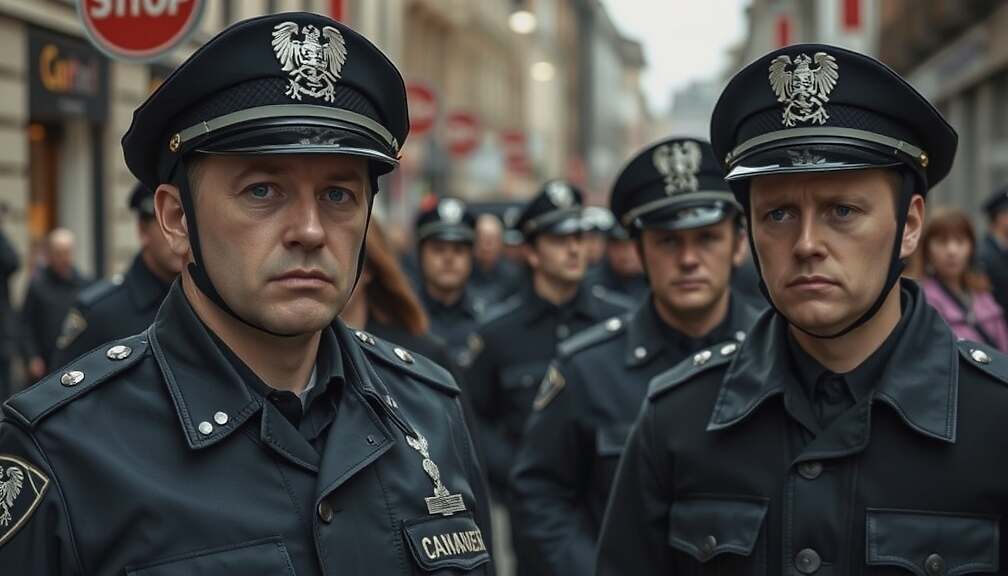
Psychological and emotional burdens faced by German police officers are markedly higher than in most other occupations, a finding reported by the union of police staff (GdP) and reviewed by the “Münchner Merkur”. The study warns that the mental strain has already caused higher rates of absenteeism and poses a medium‑term threat to public safety, according to the GdP.
The analysis draws on the German Trade Union Confederation’s (DGB) nationwide employee survey “Index Gute Arbeit” covering 2020‑2025. In that survey, 50 % of police respondents said they frequently encounter conflicts, compared with just 14 % of workers in other fields. Similarly, 18 % of police officers reported being the target of insults or disrespectful behavior, versus 10 % among other professions.
Further concerns emerged: 55 % of police officers reported often or very often having to meet demands that were hard to reconcile with other aspects of their lives, whereas the figure was 32 % for other occupational groups. Half of the officers (51 %) said they often felt rushed and under tight time pressure.
The union’s national board member, Hagen Husgen, noted that worsening mental stress is increasingly translating into long‑term illnesses and absences exceeding twelve weeks. “We are approaching a point where the still healthy staff can no longer compensate for the sick ones” he said. “In the medium term this will create a security problem”.
Husgen also called on Interior Minister Alexander Dobrindt (CSU) to address the situation, pointing out that police officers are now expected to secure additional front lines and respond to new political directives from the federal government and the minister. “We need at least 20,000 more officers to meet current demands satisfactorily, and without that more personnel will fall ill” he added.
The DGB Index surveyed a total of 36,598 employees during the period, with 296 police workers’ data included in the analysis.