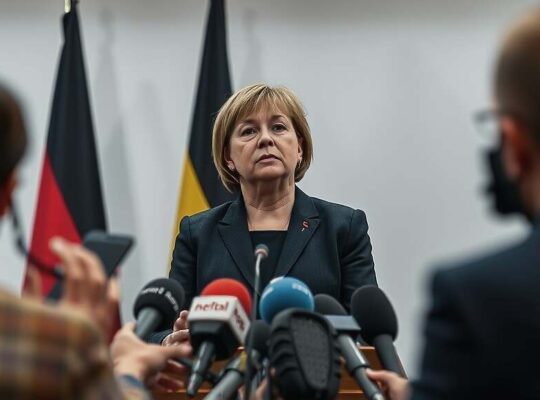
Germany’s political landscape is exhibiting a worrying trend of stagnation and disillusionment, according to a new YouGov poll released Wednesday. The survey reveals a striking equalization of support between the center-right Union bloc (CDU/CSU) and the right-wing populist Alternative for Germany (AfD), both currently polling at 26 percent. This marks a decline for the Union, losing ground compared to a month prior, while the AfD consolidates its gains.
The Green Party registers a slight increase, now at 12 percent, while the Left party experiences a marginal decrease to 10 percent. The Social Democratic Party (SPD), the junior coalition partner, remains steady at 14 percent, alongside the populist BSW and the Free Democratic Party (FDP), both at 4 percent, with other parties collectively accounting for 5 percent.
However, the statistical dead heat in national support is overshadowed by deep-seated concerns over the performance of the governing “black-red” coalition – a partnership between the CDU/CSU and SPD. A vast majority, 56 percent, now view the coalition’s collaboration as “bad” or “rather bad” a stark indictment of its perceived dysfunction. Only 14 percent believe it functions “well” or “rather well” and a mere 22 percent consider the collaboration neither positive nor negative.
The sentiment is equally bleak amongst supporters of the coalition partners. Merely 24 percent of Union voters and 27 percent of SPD voters express satisfaction with the coalition’s collaborative efforts. This suggests a growing disconnect between the party leadership and the expectations of their base.
Crucially, the poll highlights a widespread perception that the coalition has failed to deliver on promised reforms. A substantial 60 percent of respondents believe the government has enacted too few reforms to date. This sentiment permeates both Union and SPD voter bases, with 66 percent of CDU/CSU voters and 60 percent of SPD voters similarly expressing disappointment on the reform agenda. The criticism suggests a perception of indecisiveness and a lack of decisive action from the government.
The results raise serious questions about the long-term viability of the current governing structure. The convergence in support between the Union and AfD points toward potential instability and a shifting political alignment. Simultaneously, the profound dissatisfaction amongst voters, particularly regarding the pace and scope of reforms, poses a significant challenge for the coalition’s leadership and may fuel further political realignments in the months ahead. The poll surveyed 2,116 eligible voters in Germany between December 12th and 15th.