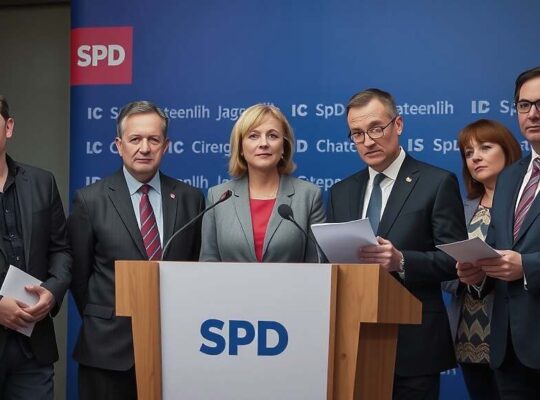
A recent poll suggests a cautious optimism regarding the stability of Germany’s fragile black-red coalition government, but significant divisions remain within the electorate. Conducted by Forsa and published in “Der Stern”, the survey reveals that 54% of German citizens anticipate the alliance between the Christian Democratic Union/Christian Social Union (CDU/CSU) and the Social Democratic Party (SPD) will endure beyond 2026. However, a substantial 40% predict a breakdown within the next year, raising concerns about the long-term viability of Chancellor Friedrich Merz’s administration.
The survey data, collected December 18th and 19th, 2025, from a sample of 1,000 respondents, indicates varying degrees of confidence along party lines. Predictably, supporters of the CDU/CSU (74%) and SPD (72%) express the most positive outlook, reflecting the vested interest in the continuation of the governing arrangement. Even a majority (73%) of Green Party voters believe the coalition will persist. Left Party voters demonstrate more tempered expectations, with only 56% supporting the coalition’s longevity.
Yet, the most striking divergence is observed within the Alternative for Germany (AfD) base. A mere 26% of AfD supporters believe the coalition will survive until the end of 2026, while a resounding 70% foresee its collapse. This starkly contrasts with the broader public sentiment and highlights the AfD’s consistent posture of antagonism toward the current government and its underlying strategies to exploit political instability for electoral gain.
The poll’s findings underscore the precarious nature of the coalition, born from necessity rather than ideological alignment. While the majority anticipates its survival, the significant minority predicting a breakdown, compounded by the deeply pessimistic outlook within a powerful opposition party like the AfD, points to simmering tensions and potential flashpoints that could destabilize German politics in the coming months. The survey raises critical questions about the coalition’s ability to navigate future challenges, maintain internal cohesion and effectively address the concerns of a divided electorate.