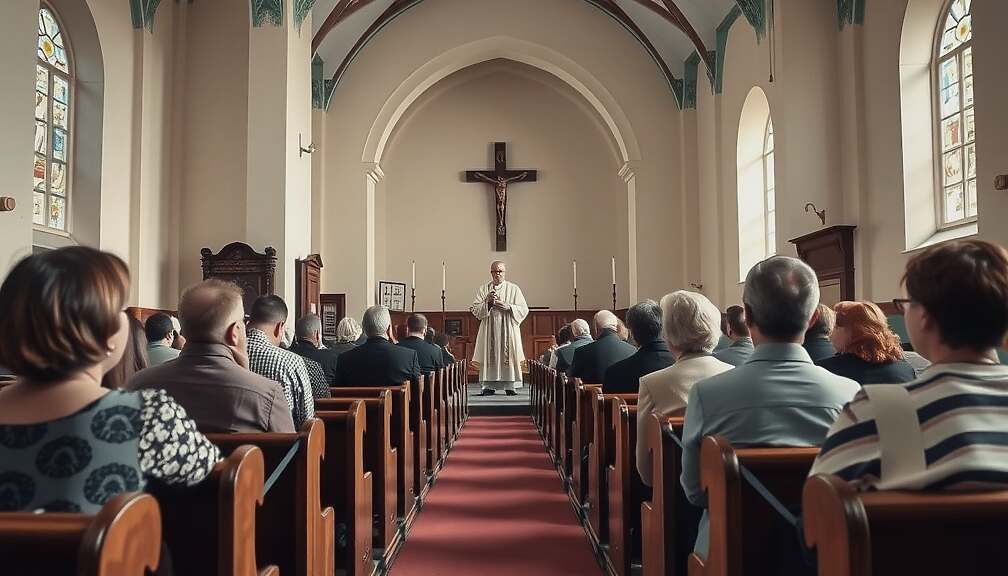
If the AfD were to take power after the September state election in Saxony‑Anhalt, local churches warn of a possible insolvency.
Karsten Wolkenhauer, president of the Evangelical State Church of Anhalt, told the “Tagesspiegel” that a new state government could simply stop paying state benefits and withholding church tax. “In less than a year we would be bankrupt” he said. Legally, taking funds away would violate the constitution, Wolkenhauer explained, but the AfD “might ignore the law and just halt the payments”. He noted that a constitutional lawsuit would likely take two to three years, during which the church would already be insolvent.
The church’s budget is about €20 million. State benefits and church tax together make up roughly half of that. If they ceased, the church would be unable to run its facilities. “Schools and day‑care centres would have to shut, as would the telephone counselling, soup kitchens and food banks. Elderly care and social welfare would collapse-let alone local communities and their everyday neighbourly work” he warned. “I take this very seriously”.
On the Catholic side, similar concerns have arisen. Bishop Gerhard Feige of the Diocese of Magdeburg told the “Tagesspiegel” that the situation is “dramatic”. While legal experts emphasise that withholding funds is not permissible, Feige noted that “President Trump is doing it right now”. “Facts are being made up, and we could litigate for years, but the money would already be gone”.
For the diocese, state benefits account for 20 % of a €38 million budget. “We do not have large reserves” Feige said. “If this happens, we would no longer be able to run parishes, schools, or social programmes”.
Wolkenhauer expressed concern that the effects might spill over beyond Saxony‑Anhalt. Because public‑law corporations cannot file for insolvency, the Evangelical Church in Germany (EKD) might have to step in. “Should a similar situation arise in Mecklenburg‑Western Pomerania, three major state churches would be at risk” he explained. State benefits alone would amount to about €70 million. “That cannot be sustained for long, not even for the EKD” Wolkenhauer added, stressing that the AfD’s platform seems engineered to fast‑track the abolition of churches, the diaconate, and thus neighbourly care.
The Catholic bishops also warned that the problem may not be confined to Saxony‑Anhalt. “Until now, nobody thought this was possible” Feige said. “But it isn’t anymore. We now have to discuss it in the bishops’ conference”. He referred to an emergency system that provides temporary help if a diocese becomes insolvent, but expressed hope that the crisis would not unfold.
When initially asked, the EKD was cautious. A spokesperson said that the work of the evangelical churches benefits all people, regardless of membership. For instance, about every second kindergarten is run under Christian auspices. “Slicing off the important social work performed by churches would mean that for many people in Germany the climate becomes colder, care and childcare more expensive, and distances longer” the spokesperson explained.