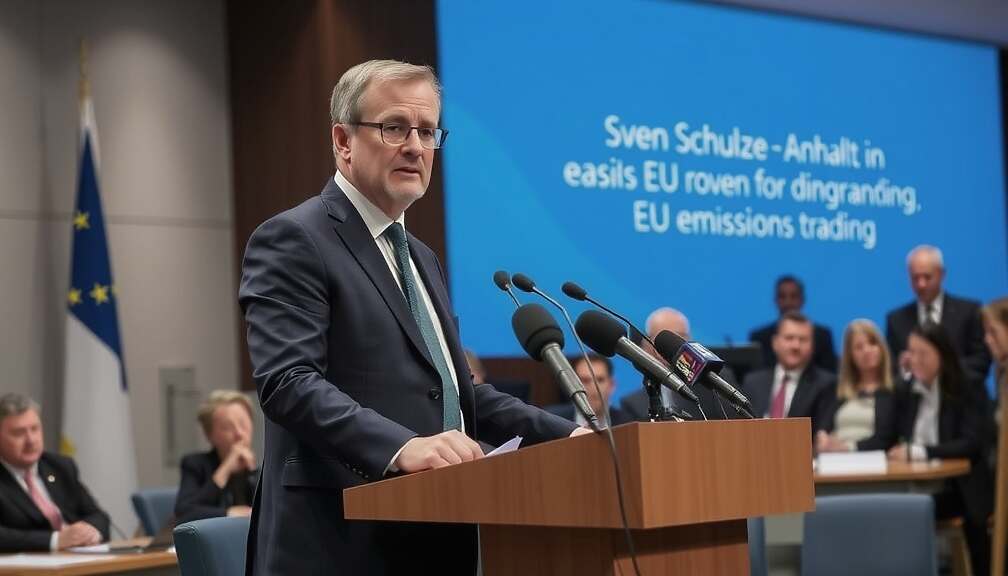
Saxony‑Anhalt’s Minister President, Sven Schulze of the CDU, has called for a loosening of Europe’s climate policy. “We need relief in the EU carbon‑certificate trading system (ETS)” he said to the ntv news portal on Friday. “The EU is withdrawing CO₂ certificates from the market, driving up the price of existing credits and, in turn, raising gas prices. We can no longer sustain this”.
In the EU Emissions Trading System for industry and energy (ETS‑1) there is a cap on CO₂ emissions. For every tonne of CO₂ equivalent-such as that released when gas is burnt-companies in the affected sectors must purchase certificates. These certificates have been distributed over several years, so the total supply of credit declines each year. If companies reduce their demand more slowly than the supply falls, the price of certificates rises. Heating gas for residential buildings is not covered by ETS‑1. A second emissions‑trading scheme (ETS‑2) will apply to the building and transport sectors starting in 2028.
Schulze also questioned the interim climate target set for 2045. “I am committed to meeting the climate goals” he said, “but becoming 90 % climate‑neutral by 2040 is already tight. If we set a goal for 2045, that would be difficult enough; otherwise we risk damaging our prosperity”. He emphasised that Germany’s climate policy must follow the 2021 ruling of the Federal Constitutional Court, which requires the country not only to set an exit date but also to stay within a defined CO₂ budget until then, with reduction burdens that cannot be excessively postponed into the future for the sake of “intertemporal freedom”.
Schulze urged Berlin to provide assistance to motorists if fuel prices remain high. “What is happening in Germany is outright gouging. The gasoline and diesel we are refuelling now could not have cost so much to produce; the oil that feeds it was purchased long before the current crisis” he said. “If this continues over a long period, we need a response mechanism from Berlin”.
He noted that many commuters in Saxony‑Anhalt travel up to 100 km to work, and “those who have a more affordable fuel supply would benefit” he added, highlighting the need for measures to ease the burden on daily drivers.