In an interview with ARD, CSU leader Markus Söder expressed strong support for Ilse Aigner, stating that he believed she would make an excellent Federal President and would be pleased if she were ultimately elected. Söder highly values Aigner and sees a “very good chance” in the current political landscape, especially considering the previous commitment that a woman should serve as president this time. He also noted with pleasure that positive signals have been coming from the SPD.
Regarding economic policy, Söder cautioned against prematurely pushing through the pension package. He described the timing of the initiative by CDU state premiers from Saxony, Thuringia, and Saxony-Anhalt as “surprising,” warning that there was a risk the entire package could be implemented too hastily. He emphasized that the Pension Commission had prepared a very “long-term pension stability” plan for all generations. This followed previous actions by CDU premiers Michael Kretschmer, Mario Voigt, and Sven Schulze, who had opposed the commission’s recommendation in favor of maintaining the “Pension at 63” system.
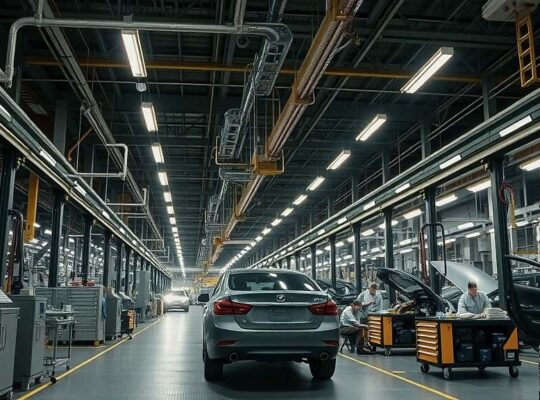
Addressing the struggles of the automotive industry, Söder stated that despite BMW announcing the reduction of 8,000 jobs last week, both major Bavarian automakers, BMW and Audi, would “survive.” He called for a revision of the e-car subsidy, arguing that it should benefit larger vehicles, not just the smallest ones, allowing German manufacturers like Mercedes, VW, Audi, and BMW to benefit. He intends for the coalition to tackle this issue starting in autumn.
Söder also noted that German car producers have “massively improved” technologically despite Chinese competition and stressed the continued importance of remaining active in the Chinese market. Furthermore, he called upon Europe to urgently grant approval for high-tech internal combustion engine vehicles, arguing that the current EU proposal is insufficient. On the topic of fuel discounts, he stated that the effects of the new “12-hour rule” would become apparent in the coming months and that its current impact is negligible. However, if this situation persists over a longer period, he suggested that the high CO2 pricing would need to be reconsidered, pending developments in Iran and the Strait of Hormuz.
Turning to political dynamics, Söder characterized the AfD as a “stabilizing anchor,” noting that while the AfD has gained ground, the CSU has remained stable. He suggested that other parties, including parts of the Greens, SPD, and Free Voters, have lost support during this period. He rejected the idea that the AfD could be countered by copying its tactics. He further argued that the AfD profits from national issues, particularly migration, not just regional politics. He stated that although fewer people have arrived, there are still many individuals who lack proper residence rights, and Germany is now very strongly focused on their return.
Söder emphasized that completing ongoing structural reforms, using the automotive industry as an example, is critical for the economy. He warned that if factories close, it becomes very easy for someone who sees no future to resort to radical decisions.
Finally, concerning the federal government, Söder dismissed speculation about potential personnel changes within the Union parliamentary group or the federal government. He strongly refuted claims that Federal Chancellor Friedrich Merz might step down following the CDU’s performance in the state elections in September. “I am firmly convinced that Friedrich Merz will remain Chancellor,” Söder asserted. He added that Merz is “very, very stable and strong,” and that his exit would completely destabilize the Union, potentially forcing new elections. Doing so, he warned, would only lead to “radicals taking power.” Therefore, he offered his urgent advice that the party should concentrate on work rather than “backroom speculation.”