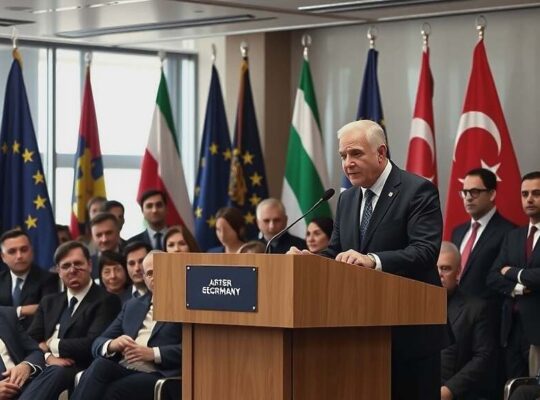
The re-election of Markus Söder as leader of the Christian Social Union (CSU) on Friday marked a significant setback for the Bavarian party, signaling potential fissures within its ranks and raising questions about its future direction. While Söder secured the position, garnering 83.6% of the votes, the result represents the party’s worst showing for an unchallenged leader since 1947. This stands in stark contrast to his previous re-election in 2023, where he achieved a resounding 96.6% endorsement and previous approval ratings consistently hovering between 87% and 91% since assuming the leadership in 2019.
The comparatively weak result, placing Söder amongst the three least-supported CSU leaders in the party’s history, underscores a shift in sentiment and potentially reflects a growing dissatisfaction amongst party members. While the absence of a challenger often guarantees a comfortable victory, the magnitude of the decline in support cannot be ignored, particularly given Söder’s previous dominance. Even his predecessor, Horst Seehofer, who faced considerable scrutiny in 2017, achieved a marginally higher percentage – 83.7%.
Prior to the vote, Söder attempted to galvanize support with a broad political statement. However, notably absent were the customary critiques directed at the CSU’s coalition partners and the Green Party. Instead, he adopted a posture of opposition to the Alternative for Germany (AfD), a strategy seemingly intended to reclaim conservative ground. Furthermore, Söder publicly championed a distinct “Bavarian path” including a complete withdrawal from the national system of fiscal equalization – a policy deeply contentious and potentially destabilizing for the broader German economy.
Analysts suggest that the muted criticism of coalition partners and the assertive advocacy for a Bavarian Sonderweg signify a strategic maneuver by Söder to consolidate his position and define a clearer ideological stance. Yet, the lackluster vote share casts doubt on the efficacy of this approach and raises questions about the cohesion within the CSU and its ability to navigate the complexities of national politics while pursuing increasingly divergent regional priorities. The result signals a period of introspection for the party, as they grapple with the implications of this significant endorsement deficit and reassess their path forward.